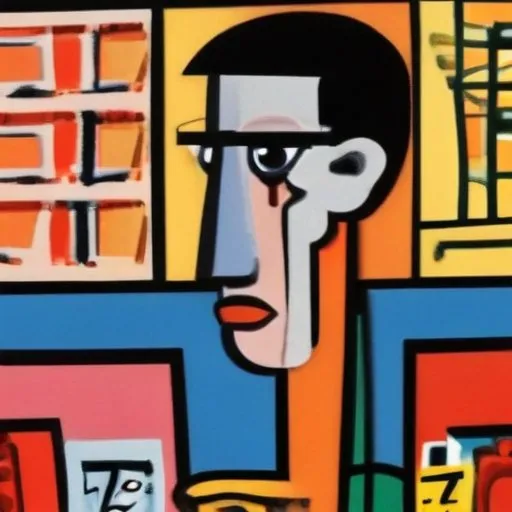
Stuart Davis

Stuart Davis

Stuart Davis was born on December 7th, 1892

Full Name: Stuart Davis
Nationality: American
Profession: Painter, Academic
Art Movement: Modernism
Style: Abstract, Cubist
Known For: Modernist painter
Influenced By: Cubism, Fauvism
Notable Works: Egg Beater No. 1

A pioneering American modernist, blending cubism and abstract expressionism to create vibrant, jazz-inspired paintings that explored the intersection of art and everyday life.

Written by: Lisa Chang Lisa Chang

The Pioneering Artist of American Modernism: Stuart Davis

A Trailblazer in Modern Art

Stuart Davis, an American modernist painter, is renowned for his vibrant, jazz-influenced, and protopop art paintings of the 1940s and 1950s, which boldly explored the intersection of art and politics. His work, characterized by bold colors, geometric shapes, and abstract forms, not only reflected the spirit of American modernism but also expressed his deep concern for the sociopolitical environment of his time.

Early Life and Training

Born on December 7, 1892, in Philadelphia, Davis was exposed to the world of art from a young age. His father, Edward Wyatt Davis, was an art editor, and his mother, Helen Stuart Davis, was a sculptor. This artistic upbringing laid the foundation for Davis's future success.

After dropping out of high school in 1909, Davis began commuting to New York City, where he started his formal art training under the tutelage of Robert Henri, the leader of the Ashcan School, at the Robert Henri School of Art. During this period, Davis befriended notable painters such as John Sloan, Glenn Coleman, and Henry Glintenkamp.

The Ashcan School and Early Career

In 1913, Davis participated in the iconic Armory Show, where he exhibited five watercolor paintings in the Ashcan school style. This milestone event not only marked Davis's arrival on the art scene but also introduced him to the works of European modernists, such as Vincent van Gogh, Henri Matisse, and Pablo Picasso.

Davis's early work was deeply rooted in the Ashcan School's realist tradition, capturing the grittiness and urban landscape of New York City. His artistic style, however, began to shift in the 1920s, as he became increasingly drawn to cubism and modernism.

Modernist Pioneer

Davis's commitment to modernism led him to become a major exponent of cubism in America. His unique style, characterized by bold colors, geometric shapes, and abstract forms, not only reflected the spirit of American modernism but also paved the way for future generations of artists.

In the 1940s and 1950s, Davis's work became even more abstract and experimental, incorporating elements of jazz and popular culture. His paintings, such as Egg Beater No. 1 (1928) and Lucky Strike (1921), are celebrated for their bold, brash, and colorful qualities.

Artistic Philosophy and Legacy

Davis's artistic philosophy was deeply rooted in his belief that art could influence the sociopolitical environment of America. Throughout his career, he remained committed to his political objectives and allegiances, refusing to waver in his artistic message.

Today, Davis is recognized as a pioneering figure in American modernism, whose work continues to inspire and influence artists, designers, and musicians. His legacy extends beyond his artistic contributions, as his commitment to social and political activism remains an enduring testament to the power of art to shape our world.

Impact on Modern Society

Davis's work not only reflected the spirit of American modernism but also contributed to shaping popular culture. His bold, colorful, and abstract paintings influenced the development of graphic design, advertising, and even jazz music.

In addition, Davis's commitment to social and political activism inspired future generations of artists to use their work as a means of addressing social and environmental issues.

Awards and Honors

Throughout his career, Davis received numerous awards and honors, including the Logan Medal of the Arts (1951) and the Gold Medal for Painting (1953) from the American Academy of Arts and Letters.

Personal Milestones and Key Life Events

Trivia and Fun Facts

Conclusion

Stuart Davis's pioneering work in American modernism continues to inspire and influence artists, designers, and musicians today. His commitment to social and political activism, as well as his bold, innovative style, have cemented his place as one of the most important American artists of the 20th century.
Timeline
1892
Birth in Pennsylvania
Stuart Davis was born on December 7th in Philadelphia, Pennsylvania. He would go on to become a renowned American painter and academic.
1909
Studies at Art Students League
Davis began studying at the Art Students League of New York, where he was influenced by modernist and cubist art.
1921
First Solo Exhibition
Davis held his first solo exhibition at the Whitney Studio Club in New York City.
1931
Teaches at Yale University
Davis began teaching at Yale University, where he would go on to influence generations of artists.
1964
Passing Away
Stuart Davis passed away on June 24th at the age of 71, leaving behind a legacy of innovative art.
Stuart Davis

Stuart Davis Quiz

What art movement did Stuart Davis blend with abstract expressionism?

Score: 0/5
FAQ
What is Stuart Daviss artistic style?
Stuart Daviss artistic style is characterized by its bold, geometric shapes and vibrant colors. He is considered a pioneer of American Modernism and his work spans several decades.
What influenced Stuart Daviss art?
Stuart Daviss art was influenced by his travels, jazz music, and the urban landscape. He was also drawn to the works of European modernists, such as Pablo Picasso and Fernand Léger.
Did Stuart Davis teach art?
Yes, Stuart Davis taught art at several institutions, including the Art Students League of New York and Yale University. He was known for his lively teaching style and his ability to inspire his students.
What awards did Stuart Davis win?
Stuart Davis won several awards for his art, including the Logan Medal of the Arts in 1957 and the Gold Medal for Painting at the 1958 Pittsburgh International Exhibition of Contemporary Painting.
Where can Stuart Daviss art be found?
Stuart Daviss art can be found in several prominent museums, including the Museum of Modern Art in New York, the Whitney Museum of American Art, and the National Gallery of Art in Washington, D.C.

Related People:

Jackson Pollock

Born in 1912

Pioneering abstract expressionist artist who splattered and dripped paint to create dynamic, emotive works that redefined modern art. Known for chaotic, intricate pieces that evoke raw emotion.

Mark Rothko

Born in 1903

A pioneer of abstract expressionism, creating bold, rectangular color fields that evoke emotions and spark introspection. His works are a testament to the power of art to transcend language and culture.

Barnett Newman

Born in 1905

A pioneer of Abstract Expressionism, creating bold, color-field paintings that evoke emotions and spirituality. His iconic "zip" paintings feature vibrant, vertical stripes that seem to pulse with energy.

Clyfford Still

Born in 1904

A pioneering abstract expressionist, creating large-scale, gestural paintings that explored the human experience and the American West. Known for his bold, expressive brushstrokes and vibrant color palette.

Robert Rauschenberg

Born in 1925

A pioneer of pop art, combining found objects and images to create innovative, thought-provoking works that blurred the lines between art and everyday life.

Jasper Johns

95 Years Old

A pioneer of pop art, creating enigmatic works that explore the relationship between perception, reality, and meaning, often using common images like flags and targets.

Andy Warhol

97 Years Old

A pioneer of pop art, creating iconic silkscreen prints of consumer products and celebrities, and experimenting with avant-garde films.

Roy Lichtenstein

Born in 1923

A pioneer of Pop Art, creating comic-book inspired paintings and sculptures that comment on consumer culture and the banality of everyday life.