


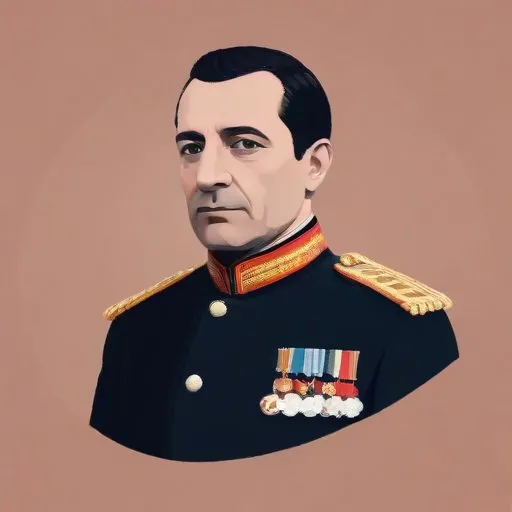
A French general and politician who played a key role in the French Revolution and served as Minister of Defence, known for his military victories and attempts to reform the French army.
Charles Franois Dumouriez, a French military officer, minister, and general, is renowned for his bravery and strategic prowess during the French Revolutionary War. His name is etched under the Arc de Triomphe, a testament to his unwavering dedication to the French Revolution and his pivotal role in shaping the country's history.
Born on January 26, 1739, in Cambrai, northern France, Dumouriez descended from a noble family. His father, Antoine Franois du Prier, served as a commissary of the royal army and ensured his son received a quality education. Dumouriez continued his studies in Paris and later joined his uncle in Versailles for a year.
In 1757, Dumouriez began his military career as a volunteer and served in six campaigns of the Seven Years War. He fought in the Battle of Rossbach as a cornet in the Régiment d'Escars and earned a commission for good conduct in action. During the battle of Corbach, he sustained 22 wounds, demonstrating his unwavering bravery.
After the Seven Years War, Dumouriez retired as a captain with a small pension and lived in Abbeville. However, his military prowess and strategic mind did not go unnoticed. He was recalled to service in 1791 and appointed as the Minister of War in the Girondin cabinet.
Alongside General Kellermann, Dumouriez achieved a decisive victory at Valmy, forcing the Prussian army to retreat. He continued his northern campaign, advancing as far as Moerdijk before returning to Brussels. Dumouriez's military tactics and leadership earned him recognition and respect from his contemporaries.
However, Dumouriez's disagreements with his successor, Pache, and the radical Convention and Jacobin deputies, including Robespierre and Marat, led to his downfall. He opposed the annexation of the wealthy Netherlands and the introduction of assignats, which led to his departure from the Revolutionary Army.
Fearing execution, Dumouriez defected to the Austrian army after losing the Battle of Neerwinden in 1793. This move sparked controversy, and Dumouriez was perceived as a traitor by the French people.
Despite his complicated legacy, Dumouriez's contributions to the French Revolution cannot be overlooked. His military victories and strategic mind played a significant role in shaping the course of the war. His name, inscribed under the Arc de Triomphe, serves as a testament to his bravery and dedication.
Dumouriez's life serves as a reminder that even the most prominent figures can face controversy and criticism. His story is a complex tapestry of heroism, strategic brilliance, and personal struggles, making him an fascinating figure in French history.
Born in 1769
A French military leader who rose to prominence during the French Revolution and became Emperor of France, known for his military conquests and reorganization of Europe. He is also famous for his Napoleonic Code, which remains a foundation of modern law.
Born in 1753
A French general, mathematician, and politician who played a crucial role in the French Revolution and is considered the "Organizer of Victory" for his military strategies, and also made significant contributions to mathematics and engineering.
Born in 1755
A key figure in the French Revolution, leading the coup that overthrew Maximilien Robespierre and later serving as a key advisor to Napoleon Bonaparte. He played a crucial role in shaping French politics during a tumultuous period.
Born in 1767
Radical Jacobin leader during the French Revolution, known for his extreme views and role in the Reign of Terror.
Born in 1758
Radical leader of the French Revolution, instrumental in the Reign of Terror, and advocate for the execution of King Louis XVI.
Born in 1759
A leading figure of the French Revolution, instrumental in the overthrow of the monarchy and establishment of the First French Republic, known for his radical Jacobin ideology.
Born in 1760
French journalist and politician who sparked the French Revolution with his impassioned speeches and writings, advocating for democracy and social reform.
Born in 1753
A French lawyer and politician who played a key role in the French Revolution, serving as a leading figure in the Girondin faction and advocating for a constitutional monarchy. He's also known for his eloquent speeches and his eventual execution by guillotine.
