


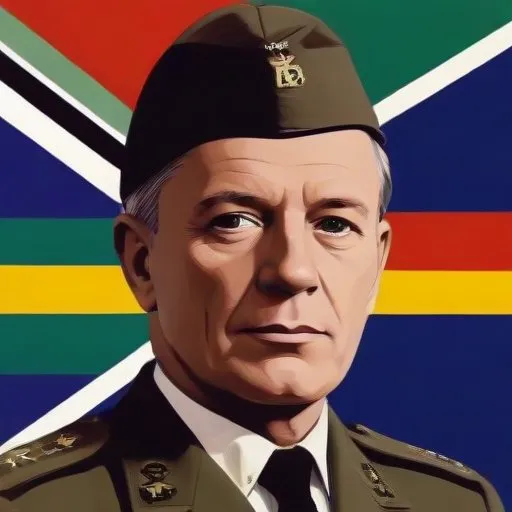
A South African-Australian colonel and politician who served in both World Wars and later became a member of the Australian Parliament, known for his military bravery and political leadership.
Charles Groves Wright Anderson is best known for being a recipient of the Victoria Cross, the highest award for gallantry in the face of the enemy that can be awarded to British and Commonwealth forces. This esteemed honor is a testament to his bravery and selflessness during World War II, where he led his battalion against the Japanese invasion of Malaya.
Anderson was born on 12 February 1897 in Cape Town, South Africa, to Scottish parents. His father, Alfred Gerald Wright Anderson, an auditor and newspaper editor, had been born in England, while his mother, Emma Maa Louise Antoinette, née Trossaert, had been born in Belgium. When Anderson was three, the family moved to Nairobi in Kenya, where his father began farming. He attended a local school until 1907, when his parents sent him to England, where he lived with family members until 1910.
Anderson's military career spanned two world wars. During World War I, he served as an officer in the East African campaign against the Germans, reaching the rank of captain and being awarded the Military Cross. After the war, he settled as a farmer in Kenya. In the early 1930s, he married an Australian woman and later moved to Australia, where he became a grazier.
In 1939, Anderson joined the Militia, Australia's part-time military force, and volunteered for overseas service after the outbreak of World War II. In early 1941, he was deployed to Malaya as part of the 8th Division, where he rose to command the 219th Battalion against the Japanese following their invasion of Malaya in December of that year.
For his actions around Muar in January 1942, Anderson was awarded the Victoria Cross. The citation reads: "For most conspicuous gallantry during the operations in Malaya, from 18th to 22nd January, 1942. Throughout the whole period, Lieutenant-Colonel Anderson showed supreme courage, and a complete disregard for his own safety. His leadership and example inspired his troops, and he personally led the most daring attacks."
After the war, Anderson returned to farming and served as a federal parliamentarian, representing the Division of Hume twice between 1949 and 1961. He was a respected voice in Australian politics, known for his commitment to rural development and his advocacy for the rights of veterans.
Anderson's personal life was marked by his love for his family and his dedication to his community. He was married twice and had four children. He passed away on 11 November 1988 at the age of 91, leaving behind a legacy of bravery, selflessness, and public service.
Today, Anderson's legacy continues to inspire generations of Australians. His Victoria Cross is on display at the Australian War Memorial in Canberra, a testament to his courage and sacrifice. His story is a reminder of the importance of bravery, leadership, and dedication to one's country.
Anderson's story is a testament to the power of courage and leadership in the face of adversity. His legacy continues to inspire and motivate generations of Australians, and his bravery and selflessness will never be forgotten.
Born in 1870
A skilled lawyer and politician who played a key role in shaping South Africa's government and served as a prominent international statesman. He's also known for his influential ideas on holism and evolution.
Born in 1901
The architect of apartheid, known for implementing and enforcing the racist segregation policies in South Africa from 1958 to 1966. His policies had a profound impact on the country's social and political landscape.
Born in 1915
The 4th State President of South Africa, a key figure in the apartheid regime, known for implementing and enforcing segregationist policies. He's infamous for his role in suppressing anti-apartheid movements.
Born in 1916
The last apartheid-era leader, notorious for enforcing racial segregation and resisting international pressure to reform, ultimately surrendering to demands for democratic elections.
90 Years Old
The last State President of apartheid-era South Africa who led the country's transition to democracy and was awarded the Nobel Peace Prize for his efforts. He's known for his role in releasing Nelson Mandela from prison and dismantling the apartheid system.
Born in 1918
A South African lawyer and politician who fought against apartheid, becoming the country's first black president and a symbol of racial reconciliation, earning a Nobel Peace Prize. He's a beacon of hope and freedom.
