


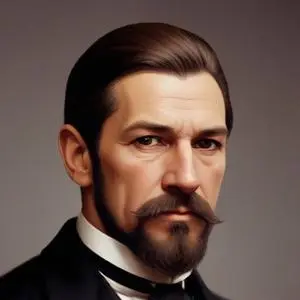
The assassin who shot President James A. Garfield in 1881, leading to his death 79 days later, and is infamous for his motivations of seeking a government job. This event led to significant changes in presidential security and medical practices.
Charles J. Guiteau is notoriously known for assassinating the 20th President of the United States, James A. Garfield, in 1881. This senseless act of violence led to Garfield's death two months later, sending shockwaves throughout the nation.
Charles Julius Guiteau was born on September 8, 1841, in Freeport, Illinois, to Jane August Howe and Luther Wilson Guiteau. He was the fourth of six children, and his family had French Huguenot ancestry. After his mother's death in 1848, Guiteau moved to Ulao, Wisconsin, with his family, where he lived until 1855.
In 1860, Guiteau inherited $1,000 (equivalent to $34,000 in 2023) from his grandfather and planned to attend the University of Michigan. However, he failed the entrance examinations due to inadequate academic preparation. He then crammed in French and algebra at Ann Arbor High School in Ann Arbor, Michigan, but quit school before completing the program.
In June 1860, Guiteau joined the Oneida Community, a utopian religious sect in Oneida, New York, which his father had a close affiliation with. Guiteau worshipped the group's founder, John Humphrey Noyes, and wrote that he had "perfect, entire and absolute confidence in him in all things." This community had a significant impact on Guiteau's beliefs and worldview.
Guiteau falsely believed that he had played a major role in Garfield's election victory and felt entitled to a consulship in Vienna or Paris. Repeatedly rejected by the Garfield administration, Guiteau became increasingly frustrated and offended. On July 2, 1881, he shot President Garfield at the Baltimore and Potomac Railroad Station in Washington, D.C. Garfield died two months later from infections related to the wounds.
In January 1882, Guiteau was sentenced to death for the crime. During his trial, Guiteau's behavior was erratic, and he often disrupted proceedings. He was hanged five months later, on June 30, 1882, at the Washington D.C. Jail.
Guiteau's actions had a profound impact on American history, leading to a shift in the way presidents interact with the public. His assassination of President Garfield also led to increased security measures for government officials. Guiteau's legacy serves as a cautionary tale about the dangers of unchecked ambition and the devastating consequences of violent acts.
In conclusion, Charles J. Guiteau's infamous act of violence will forever be remembered as a dark chapter in American history. His misguided beliefs and actions led to the tragic death of President James A. Garfield, leaving a lasting impact on the nation.
Born in 1831
The 20th President of the United States was a multifaceted leader who served as a general in the Civil War and later became a lawyer and politician, known for his strong advocacy for education and civil rights. He's also infamous for being assassinated just six months into his presidency.
Born in 1829
The 21st President of the United States, a strong advocate for civil service reform, is most known for signing the Pendleton Civil Service Act, which transformed the federal government's hiring practices. He's also remembered for his unexpected rise to presidency after the assassination of James A. Garfield.
Born in 1843
The son of President Abraham Lincoln, he served as Secretary of War under President James A. Garfield and later as Ambassador to the United Kingdom, playing a key role in international diplomacy. He was also a successful lawyer and businessman.
Born in 1838
Notorious actor-turned-assassin who fatally shot the 16th President of the United States, Abraham Lincoln, at Ford's Theatre in 1865.
86 Years Old
The assassin who fatally shot President John F. Kennedy in Dallas, Texas, on November 22, 1963, sparking a national tragedy and conspiracy theories. Known for his infamous act that changed American history.
71 Years Old
Attempted assassin of President Ronald Reagan in 1981, motivated by an obsession with actress Jodie Foster. This event led to significant changes in gun control laws and presidential security.
Born in 1873
The anarchist who assassinated President William McKinley at the 1901 Pan-American Exposition in Buffalo, New York, sparking widespread outrage and calls for stricter security measures. This event led to the creation of the Secret Service protection for U.S. presidents.
Born in 1900
An Italian-American anarchist who attempted to assassinate President-elect Franklin D. Roosevelt, but instead killed the mayor of Chicago, Anton Cermak, in 1933.
