


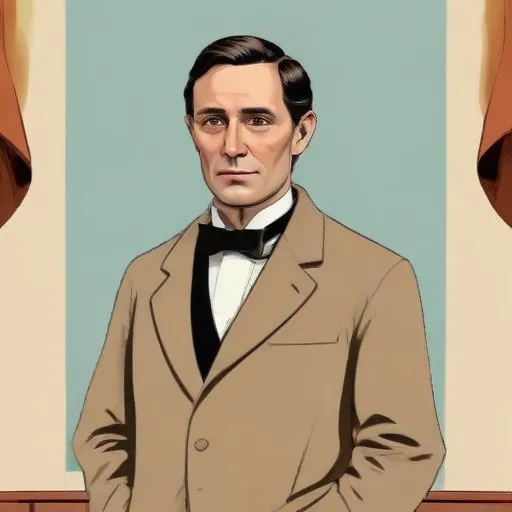
An American zoologist who studied and classified various species, particularly fish and reptiles, making significant contributions to the field of herpetology. His work helped shape our understanding of these species and their habitats.
Charles Lincoln Edwards was a renowned American zoologist, known for his groundbreaking research on the development of reptiles and sea cucumbers, as well as his significant contributions to the field of taxonomy, particularly in the classification of sea cucumbers and copepods. His work led to the discovery of at least five new species of copepods found in sea cucumber body cavities.
Edwards was born on December 8, 1863, in Oquawka, Illinois, to John and Nancy Stockton Edwards. His father, of Welsh descent, was a banker and member of the Indiana legislature. Edwards attended Lombard College, where he joined the Lambda prime chapter of Delta Tau Delta, and later transferred to the University of Minnesota, where he founded the Beta Eta Chapter of Delta Tau Delta in 1883.
Edwards obtained his Ph.D. from the University of Leipzig in 1890, after which he worked as a graduate fellow at Clark University, Massachusetts, and later became an assistant professor of biology at the University of Tennessee.
His research focused on the developmental biology of reptiles and sea cucumbers, as well as the taxonomy of copepods and sea cucumbers.
Edwards was a fellow of the American Association for the Advancement of Science and a member of several prominent scientific organizations, including the American Society of Zoologists, the American Society of Naturalists, and the Southern California Academy of Sciences.
In addition to his work in zoology, Edwards had a strong interest in folklore, which led him to author the book "Bahama Songs and Stories". He was also the president of the American Folklore Society in 1889.
Edwards was recognized for his lifetime involvement with Delta Tau Delta, and was inducted into the Distinguished Service Chapter.
Charles Lincoln Edwards' contributions to the field of zoology, particularly in the areas of developmental biology and taxonomy, have had a lasting impact on our understanding of the natural world. His work continues to inspire future generations of scientists and researchers.
Edwards refounded the Beta Alpha chapter of Delta Tau Delta while at Indiana University.
He served as Western Division President of Delta Tau Delta from 1883 to 1884.
Charles Lincoln Edwards' remarkable life and career serve as a testament to his dedication to scientific inquiry and his passion for understanding the natural world.
Born in 1858
A pioneering leader who championed progressive reforms, trust-busting, and conservation, earning a Nobel Peace Prize for mediating the Russo-Japanese War. He's also famous for his rugged outdoorsmanship and "big stick" diplomacy.
Born in 1838
A pioneering conservationist and writer who advocated for the preservation of America's wilderness and national parks, inspiring generations to appreciate and protect the natural world.
Born in 1860
A renowned outdoorsman and conservationist, he wrote influential books on wildlife and the wilderness, inspiring generations to appreciate and protect nature.
Born in 1785
A pioneering ornithologist and artist, famous for meticulously illustrating and documenting North American bird species in his iconic book "The Birds of America". His work remains a cornerstone of ornithology and wildlife art.
