


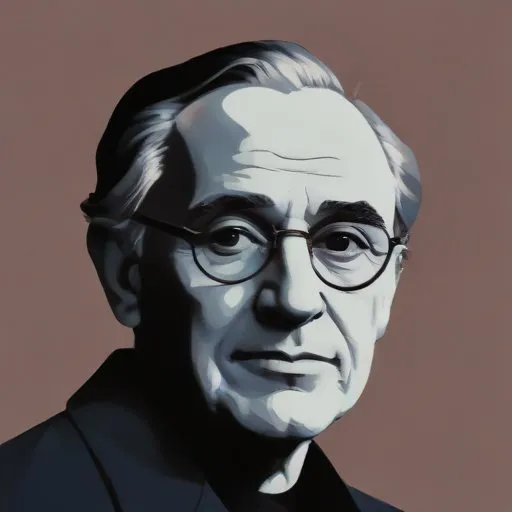
A leading figure of the Black Mountain poetry movement, known for his innovative and influential poetry that explored themes of history, mythology, and the human condition.
Charles Olson, a second-generation modernist American poet, is renowned for bridging the gap between earlier modernist figures like Ezra Pound and William Carlos Williams and the third-generation modernist New American poets. As a key figure in moving American poetry from modernism to postmodernism, Olson's work continues to inspire and influence contemporary poetry.
Born on December 27, 1910, in Worcester, Massachusetts, Olson grew up in a family of modest means. His father, Karl Joseph Olson, worked as a mail carrier, and the family spent summers in Gloucester, Massachusetts, which would later become the focus of Olson's writing. As a champion orator in high school, Olson won a tour of Europe, where he met the esteemed poet William Butler Yeats.
Olson's academic pursuits took him to Wesleyan University, where he graduated Phi Beta Kappa in 1932 with a degree in English literature. He went on to earn an M.A. in English literature with a thesis on Herman Melville's oeuvre in 1933. Olson's research on Melville continued at Wesleyan during the 1933-1934 academic year, supported by a partial fellowship.
In 1936, Olson entered Harvard University as a doctoral student in English, eventually joining the newly formed doctoral program in American Civilization as one of its first three candidates. Although he completed his coursework by 1939, Olson failed to finish his dissertation and take the degree. This marked a turning point in his career, as he began to focus on his poetry and writing.
In the 1950s, Olson became a central figure in the Black Mountain School of poetry, a movement that emphasized experimentation, improvisation, and a rejection of traditional forms. His poetry, characterized by its use of imagery, fragmentation, and open forms, resonated with the likes of Robert Creeley, Robert Duncan, and John Wieners.
Olson's poetry and philosophy were deeply intertwined. He believed that poetry should be a direct, unmediated expression of the self, unfettered by traditional forms and conventions. In his essay "Projective Verse," Olson outlined his vision for a new kind of poetry, one that would be more spontaneous, more expressive, and more attuned to the natural world.
Olson's philosophy extended beyond poetry to encompass a broader understanding of human experience. He believed in the importance of exploring the human condition, of delving into the depths of human emotion and experience. His poetry and essays reflect this concern, often blurring the lines between the personal and the universal.
Today, Charles Olson is widely regarded as a key figure in American poetry. His work has influenced generations of poets, from the Beats to the Language poets. His emphasis on experimentation, improvisation, and the importance of the individual voice has helped shape the course of American poetry.
Olson's legacy extends beyond poetry to encompass the broader cultural and intellectual landscape. His work continues to inspire artists, writers, and thinkers, offering a vision of a more authentic, more expressive, and more human way of living.
These quotes capture the essence of Olson's philosophy and poetry, emphasizing the importance of process, space, and the human experience.
Charles Olson's life and work continue to inspire and influence contemporary poetry, offering a vision of a more authentic, more expressive, and more human way of living. As an archeologist of morning, Olson excavates the depths of human experience, revealing the beauty, complexity, and richness of the human condition.
Born in 1926
A celebrated poet, novelist, and essayist, known for his unique, concise, and emotive writing style that explored the human experience. His work often blurred the lines between poetry and prose.
79 Years Old
A British bassist and member of the 1960s rock band The Animals, known for his melodic and rhythmic playing style that helped shape the band's blues-infused sound.
Born in 1926
A prominent figure in the New York School of poets, known for his spontaneous, conversational style and poems that capture the essence of urban life and the human experience.
Born in 1926
A leading figure of the Beat Generation, known for his poetry that explores themes of nonconformity, free expression, and social justice. His iconic poem "Howl" is a classic of American literature.
Born in 1922
Pioneering figure of the Beat Generation, known for spontaneous, confessional, and poetic writings that captured the essence of American counterculture in the 1950s and 60s.
Born in 1883
A physician-turned-writer, known for his modernist poetry and short stories that explored the everyday lives of ordinary people, often using imagery and experimental styles. His work blurred the lines between poetry and prose, creating a unique literary voice.
Born in 1885
A pioneering modernist poet and critic who transformed 20th-century literature with innovative styles and provocative ideas, shaping the course of modern poetry.
Born in 1917
A confessional poet who pioneered the personal, free-verse style, exploring themes of family, history, and mental illness in his work. He's known for his raw, introspective, and emotionally charged poetry.
