


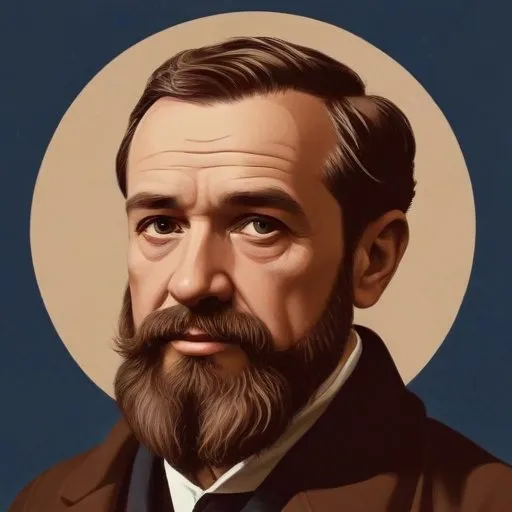
A pioneering astronomer who made significant contributions to the field, including being the first to measure the height of the Canary Islands and advocating for the use of mountaintop observatories.
Charles Piazzi Smyth, a British astronomer, is renowned for his groundbreaking innovations in astronomy and his extensive research on the Great Pyramid of Giza. Alongside his wife, Jessica Duncan Piazzi Smyth, he delved into pyramidology and metrology, uncovering the mysteries of the ancient wonder.
Born on January 3, 1819, in Naples, Kingdom of the Two Sicilies, Piazzi Smyth was named after his godfather, the Italian astronomer Giuseppe Piazzi. His father, Captain William Henry Smyth, equipped an observatory at Bedford, where Piazzi Smyth received his initial lessons in astronomy. He was educated at Bedford School until the age of sixteen, when he became an assistant to Sir Thomas Maclear at the Cape of Good Hope.
It was during his time at the Cape of Good Hope that Piazzi Smyth observed Halley's comet and the Great Comet of 1843, and actively participated in the verification and extension of Nicolas Louis de Lacaille's arc of the meridian. In 1846, he was appointed Astronomer Royal for Scotland, taking up the position at the Calton Hill Observatory in Edinburgh, and became professor of astronomy at the University of Edinburgh.
Piazzi Smyth's most notable work in astronomy was done outside of his official capacity, largely due to the underfunding of the Calton Hill Observatory. Despite these challenges, he completed the reduction and continued the series of observations made by his predecessor, Thomas James Henderson. In 1853, he successfully installed a time ball on top of Nelson's Monument in Edinburgh, providing a time signal to ships at the port of Leith. This visual signal was later augmented by the One O'Clock Gun at Edinburgh Castle in 1861.
Piazzi Smyth's work on the Great Pyramid of Giza is perhaps his most enduring legacy. Alongside his wife, he conducted extensive research on the pyramid's architecture, geometry, and metrology. His book, Our Inheritance in the Great Pyramid, published in 1864, presented his findings and theories on the pyramid's construction and significance.
Piazzi Smyth believed that the Great Pyramid was a repository of ancient wisdom, containing geometric and mathematical principles that could be applied to modern science. His work in pyramidology and metrology has sparked controversy and debate among scholars, with some considering him a pioneering figure in the field, while others view his theories as speculative and unproven.
Piazzi Smyth's legacy is marked by both praise and criticism. While his contributions to astronomy are undeniable, his work on the Great Pyramid has been met with skepticism by some scholars. Nevertheless, his research has inspired generations of pyramidologists and metrologists, and his theories continue to be debated and explored.
Throughout his life, Piazzi Smyth was driven by an insatiable curiosity and a passion for discovery. His work, though sometimes controversial, reflects his unwavering commitment to uncovering the secrets of the universe.
Born in 1843
A pioneering astronomer who cataloged stars and made precise measurements of celestial bodies, revolutionizing our understanding of the universe.
Born in 1792
Developed a system of mathematical astronomy, cataloging over 2,500 nebulae and star clusters, and made significant contributions to the field of photography. His work laid the foundation for modern astronomy and astrophysics.
Born in 1738
A pioneering astronomer and musician who discovered Uranus and two of its moons, and also composed symphonies and concertos.
Born in 1750
First female astronomer to receive a salary, discovered several comets and double stars, and assisted her brother William in his astronomical observations.
Born in 1774
A Scottish minister, author, and educator who wrote influential books on astronomy, theology, and education, and was a pioneer in promoting science and literacy in the early 19th century.
Born in 1790
A Scottish clergyman and inventor who developed the Stirling engine, a highly efficient heat engine that converts thermal energy into mechanical work. His design has been used in various applications, including cryogenics and space exploration.
