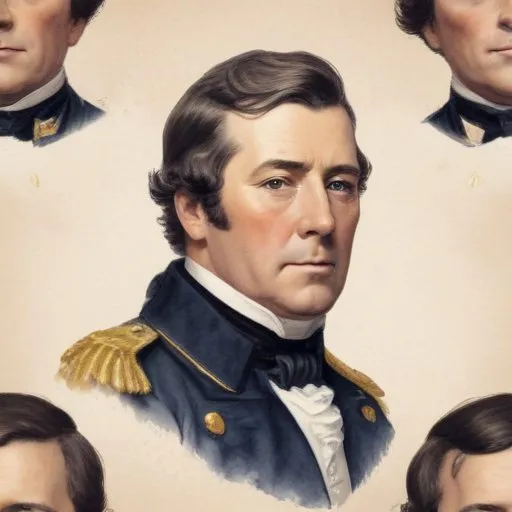
Charles Wilkes: A Pioneering Naval Officer, Explorer, and Diplomat
A Legacy of Exploration and Diplomacy
Charles Wilkes is best known for leading the United States Exploring Expedition (1838-1842), one of the most significant scientific expeditions in American history, and for his role in the Trent Affair during the American Civil War. As a naval officer, explorer, and diplomat, Wilkes left an indelible mark on the fields of oceanography, cartography, and international relations.
Early Life and Education
Born on April 3, 1798, in New York City, Charles Wilkes was the great-nephew of
John Wilkes, the former Lord Mayor of London. Following his mother's death in 1802, Wilkes was raised by his aunt,
Elizabeth Ann Seton, who later became the first American-born woman canonized a saint by the Catholic Church. Wilkes' fluency in French, acquired through his aunt's instruction, would serve him well throughout his career.
Naval Career and Expeditions
Wilkes entered the United States Navy as a midshipman in 1818 and became a lieutenant in 1826. In 1833, he was placed in charge of the Navy's Department of Charts and Instruments, which later developed into the Naval Observatory and Hydrographic Office. His interdisciplinary expedition (1838-1842) set a benchmark for physical oceanography, earning him recognition as a pioneering figure in the field. The expedition's findings also contributed significantly to the development of the Naval Observatory and Hydrographic Office.
The Trent Affair and the American Civil War
During the American Civil War, Wilkes commanded the USS San Jacinto, which intercepted the British mail ship Trent, removing two Confederate diplomats and nearly sparking war between the United States and the United Kingdom. This bold move solidified Wilkes' reputation as a skilled and courageous naval officer.
Awards and Honors
Wilkes was elected to the American Philosophical Society in 1843, a testament to his contributions to the fields of science, exploration, and diplomacy. His work also earned him recognition from the National Academy of Sciences and the Columbian Institute.
Philosophical Contributions and Beliefs
Throughout his career, Wilkes demonstrated a deep commitment to scientific inquiry and exploration. His expeditions and writings reflect a profound appreciation for the natural world and a dedication to expanding human knowledge.
Legacy and Historical Context
Charles Wilkes' expeditions and writings not only expanded America's understanding of the world but also contributed significantly to the development of oceanography, cartography, and international relations. His legacy serves as a testament to the power of scientific inquiry and the importance of diplomacy in international relations.
Personal Milestones and Key Life Events
- Born on April 3, 1798, in New York City
- Raised by aunt Elizabeth Ann Seton
- Entered the United States Navy as a midshipman in 1818
- Became a lieutenant in 1826
- Led the United States Exploring Expedition (1838-1842)
- Commanded the USS San Jacinto during the Trent Affair (1861)
- Died on February 8, 1877
FAQ
What was Charles Wilkess role in the United States Navy?
Charles Wilkes was an American admiral, geographer, and explorer who played a key role in the development of the United States Navy. He led several important expeditions, including the United States Exploring Expedition of 1838-1842.
What were Charles Wilkess most notable achievements?
Charles Wilkess most notable achievement was leading the United States Exploring Expedition, which mapped many previously unknown islands and coastlines in the Pacific Ocean.
How did Charles Wilkess expedition impact American geography?
Charles Wilkess expedition had a significant impact on American geography, providing new and accurate maps of many previously unknown regions. The expedition also helped to establish the United States as a major naval power.
What was Charles Wilkess role in the development of American science?
Charles Wilkes played an important role in the development of American science, particularly in the fields of oceanography and geology. His expedition collected many important scientific specimens and data.
What is Charles Wilkess legacy in American history?
Charles Wilkes is remembered as one of the most important American explorers of the 19th century. His expedition helped to establish the United States as a major naval power and contributed significantly to the development of American science.