


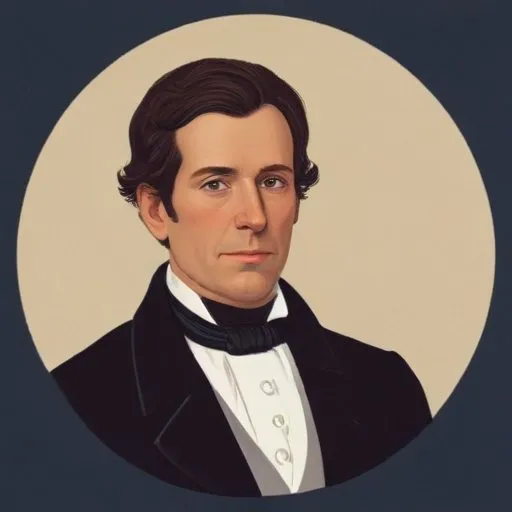
Pioneering oceanographer who charted the world's oceans, creating the first accurate maps of sea currents and depths, revolutionizing navigation and commerce. Known as the "Pathfinder of the Seas".
Matthew Fontaine Maury, nicknamed the Pathfinder of the Seas, was an American oceanographer and naval officer who revolutionized the field of oceanography with his groundbreaking work on navigation, meteorology, winds, and currents. His seminal book, The Physical Geography of the Sea (1855), remains a foundational text in the field, providing the first comprehensive understanding of the world's oceans.
Born on January 14, 1806, in Virginia, Maury's fascination with the sea began at a young age. At 19, he obtained a midshipman's warrant in the United States Navy, courtesy of U.S. Representative Sam Houston. As a midshipman on board the frigate USS Brandywine, Maury commenced his studies of the seas, meticulously recording methods of navigation.
Maury's work transformed the way sailors navigated the oceans. He developed a uniform system of recording oceanographic data, which was adopted by navies and merchant marines worldwide. His groundbreaking publication, the Wind and Current Chart of the North Atlantic, enabled sailors to harness the power of ocean currents and winds, significantly reducing the length of ocean voyages.
In 1844, Maury was appointed Superintendent of the Depot of Charts and Instruments, later renamed the United States Naval Observatory. During his tenure, he studied thousands of ships' logs and charts, laying the foundation for modern oceanography. His work at the observatory enabled him to develop charts for all major trade routes, solidifying his reputation as a visionary in the field.
With the outbreak of the American Civil War, Maury resigned his commission as a U.S. Navy commander and joined the Confederacy. He spent the war years in the Southern United States, Great Britain, and France, serving as a Confederate envoy. Following the war, Maury was pardoned and accepted a teaching position at the Virginia Military Institute, where he remained until his death in 1873.
Matthew Fontaine Maury's contributions to oceanography have had a lasting impact on modern society. His work has inspired generations of oceanographers, and his legacy extends beyond the scientific community. His vision for a more efficient and safer navigation system has facilitated global trade, commerce, and exploration.
Maury's work has been recognized with various honors and awards. He was elected to the American Philosophical Society in 1853 and received the Order of the Golden Spur from the King of Italy in 1861.
Maury's personal life was marked by tragedy, including the loss of his daughter in 1849. Despite these challenges, he remained dedicated to his work, driven by a passion for understanding the mysteries of the ocean.
One anecdote highlights Maury's determination: during a particularly grueling lecture tour, he was forced to pause due to exhaustion. Undeterred, he completed the tour, earning a reputation as a tireless advocate for oceanography.
Matthew Fontaine Maury's groundbreaking work has left an indelible mark on the field of oceanography. His contributions continue to inspire new generations of scientists, navigators, and explorers, cementing his legacy as the Pathfinder of the Seas.
Born in 1564
Pioneering astronomer, physicist, and mathematician who played a major role in the Scientific Revolution, making key discoveries that challenged Aristotelian views and laid the foundation for modern science.
Born in 1867
A pioneering scientist who pioneered radioactivity research, discovering elements polonium and radium, and paving the way for breakthroughs in medicine and energy.
Born in 1809
Developed the theory of evolution through natural selection, revolutionizing our understanding of life on Earth. This groundbreaking idea transformed the fields of biology, ecology, and beyond.
Born in 1879
A brilliant physicist who developed the theory of relativity and is considered one of the most influential scientists of the 20th century, known for his groundbreaking work in physics and mathematics.
Born in 1473
A Renaissance-era mathematician and astronomer who proposed the heliocentric model, where the Sun is at the center of our solar system, revolutionizing our understanding of the universe.
Born in 1546
A 16th-century astronomer who made precise measurements of the stars and planets, laying the foundation for modern astronomy. His data helped Kepler discover planetary orbits.
Born in 1571
A 17th-century trailblazer who discovered the three laws of planetary motion, revolutionizing our understanding of the solar system. He's also credited with being a pioneer in the field of astrology.
Born in 1656
Predicted celestial events, including the return of a comet that bears his name, and made significant contributions to navigation, astronomy, and mathematics.
