


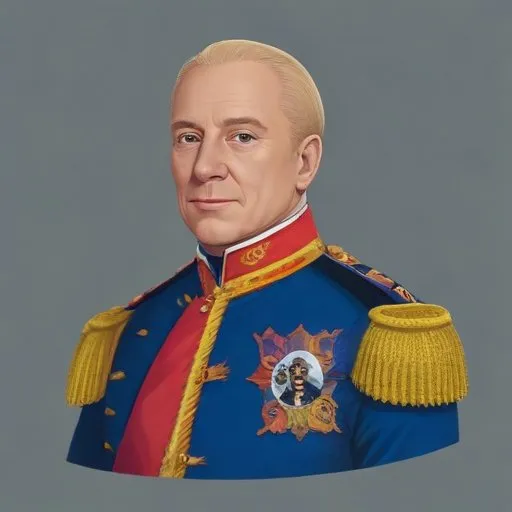
King of Sweden and Norway from 1809 to 1818, known for his role in the Finnish War and the Convention of Moss, which led to the union of Sweden and Norway.
Charles XIII of Sweden, a member of the House of Holstein-Gottorp, is famously known for being the King of Sweden from 1809 to 1818, as well as the King of Norway from 1814 to 1818. His reign, although brief, marked a significant turning point in Swedish history, as he oversaw the country's transition from an absolute monarchy to a constitutional one.
Born on October 7, 1748, in Stockholm, Sweden, Charles XIII was the youngest son of Adolph Frederick of Sweden and Louisa Ulrika of Prussia. His childhood was marked by the intrigue and politics of the royal court, where his mother played a significant role in shaping his early life. Despite being seventh in line to the throne, Charles's family connections and strategic marriages propelled him towards the crown.
In 1809, following a series of coups and power struggles, Charles XIII was unexpectedly crowned King of Sweden, much to the dismay of his rival, Gustav IV Adolf. The newly crowned king faced the daunting task of rebuilding a nation reeling from financial crisis, military defeat, and internal strife. His early reign was marked by a series of reforms, including the adoption of the Instrument of Government in 1809, which limited the monarch's power and introduced constitutional rule.
In 1814, Charles XIII played a pivotal role in the formation of the United Kingdoms of Sweden and Norway, following the Treaty of Kiel. This union, although short-lived, marked a significant shift in Scandinavian politics. During his later reign, Charles XIII faced opposition from the Norwegian nobility, who sought greater autonomy and eventually declared independence in 1814.
Despite his tumultuous reign, Charles XIII is remembered for his cultural contributions to Sweden. He was a patron of the arts and sciences, and his court attracted prominent intellectuals and artists. The king's personal life was marked by tragedy, including the loss of his wife, Charlotte of Mecklenburg-Strelitz, and his struggles with poor health. Charles XIII died on February 5, 1818, at the age of 69, leaving behind a legacy of reform and transition.
Charles XIII's reign took place during a period of great upheaval in Europe, with the French Revolution and the Napoleonic Wars reshaping the continent. His adoption of constitutional rule and his role in the formation of the United Kingdoms of Sweden and Norway had far-reaching consequences for Scandinavian politics and identity. Today, Charles XIII is remembered as a complex and often contradictory figure, whose reforms and legacy continue to shape modern Sweden.
Through his reforms and cultural contributions, Charles XIII left an indelible mark on Swedish history, cementing his place as a significant figure in the country's transition towards modernity. Despite the controversies and challenges of his reign, his legacy continues to inspire and captivate historians and scholars to this day.
Born in 1746
King of Sweden from 1771 to 1792, known for his cultural and artistic achievements, and his assassination at a masquerade ball. He was a patron of the arts and a strong leader who modernized Sweden's government and economy.
Born in 1778
King of Sweden from 1792 to 1809, known for his disastrous foreign policy and military failures, leading to the loss of Finland to Russia.
Born in 1763
King of Sweden and Norway who ruled from 1818 to 1844, known for modernizing and liberalizing his countries' governments and economies.
Born in 1829
King of Sweden and Norway from 1872 to 1907, known for his diplomatic efforts to maintain Scandinavian unity and neutrality during the tumultuous late 19th century.
80 Years Old
The current monarch of Sweden, reigning since 1973, known for modernizing the monarchy and promoting Swedish culture and trade. He's also the head of the Nobel Prize ceremonies.
Born in 1872
The first king of Norway after the country's independence from Sweden, he played a crucial role in maintaining Norway's sovereignty during World War II. He's revered for his bravery and leadership during the war.
Born in 1818
The King of Denmark who unified the country and founded the modern Danish monarchy, known for his strong leadership and family ties to European royal houses.
Born in 1723
King of Denmark and Norway from 1746 to 1766, known for his cultural and economic reforms, as well as his patronage of the arts.
