


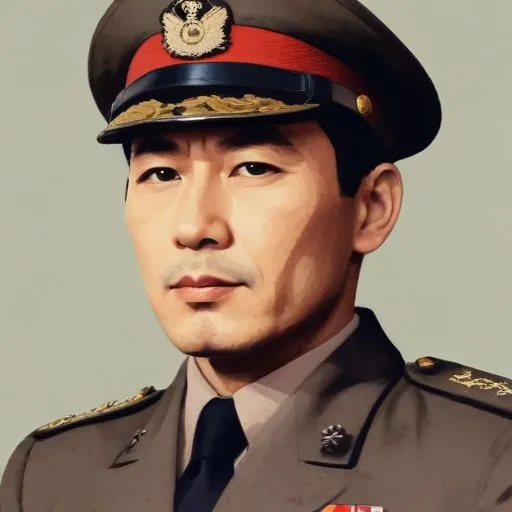
A Japanese lieutenant, engineer, and politician who founded a prominent aircraft company, playing a significant role in Japan's aviation industry during World War II. He's known for his innovative designs and contributions to military aviation.
Chikuhei Nakajima was a pioneering Japanese businessman, naval engineer, naval officer, and politician who revolutionized the aviation industry by founding Nakajima Aircraft Company in 1917, a major supplier of airplanes in the Empire of Japan. As a trailblazer in the field, Nakajima played a significant role in shaping Japan's aviation industry, leaving an indelible mark on the country's history.
Born on January 1, 1884, in Nitta District, Gunma, Nakajima grew up in a farming family. His early interest in engineering and aviation led him to attend the Imperial Japanese Naval Engineering School, where he graduated from the 15th class in 1907. He was promoted to Ensign in 1908, marking the beginning of his illustrious career.
Nakajima's remarkable achievements in aviation include piloting Japan's first airship on October 27, 1911. He was also commissioned as a lieutenant in the Imperial Japanese Navy in 1911. After graduating from the Naval Staff College in 1912, he was sent to the United States for further studies, where he became the 3rd Japanese to receive a pilot's license upon graduation from a flight school established by Glenn Curtiss.
In 1915, Nakajima drafted the first paper advocating for the bombing of civilians to crush a nation's resistance morale, a concept that would later become known as terror bombing. Although controversial, his ideas showcased his forward-thinking approach to modern warfare.
In 1917, Nakajima returned to Japan and resigned from the military as a Lieutenant. He opened a company to produce aircraft in Japan, with financial support from fellow engineer Seibei Kawanishi. The company, initially called Nihon Hikoki Seisakusho KK (Japanese Aeroplane Manufacturing Work Co. Ltd.), would later become the Nakajima Aircraft Company after the partners split in 1919. The same year, the company received its first order for 20 aircraft from the Japanese military, cementing Nakajima's legacy in the aviation industry.
Nakajima ventured into politics in the 1930 General Election, when he was elected to the Japanese Diet. He continued to serve as a cabinet minister, further solidifying his influence in Japanese politics. Nakajima passed away on October 29, 1949, leaving behind a rich legacy that continues to inspire generations.
Chikuhei Nakajima's pioneering spirit, innovative ideas, and entrepreneurial drive transformed Japan's aviation industry, earning him a place in history as one of the country's most influential figures. His contributions continue to inspire awe, and his legacy serves as a testament to the power of vision, determination, and hard work.
Today, Nakajima's story serves as a beacon of inspiration, reminding us of the importance of innovation, perseverance, and vision in shaping our collective future.
Born in 1901
The Japanese emperor who ruled from 1926 to 1989, leading the country through World War II and its post-war reconstruction, and is known for his symbolic role in Japanese politics and culture. He is also remembered for his rare public apology for Japan's wartime atrocities.
Born in 1884
Led the Imperial Japanese Navy during World War II, masterminding the surprise attack on Pearl Harbor, and later became a symbol of Japanese military power and strategy.
Born in 1887
Led the Nationalist Party in China, fighting against the Communist Party and later establishing the government of Taiwan. He's known for his role in shaping modern Chinese history.
Born in 1893
Leader of the Chinese Communist Party who implemented radical social and economic reforms, including the Great Leap Forward and the Cultural Revolution, shaping modern China's politics and economy.
Born in 1878
The Soviet Union's ruthless leader who ruled with an iron fist, implementing policies that led to widespread famine and purges, while also playing a crucial role in defeating Nazi Germany in World War II.
Born in 1871
Prolific writer of historical novels and adventure stories, also a talented landscape painter.
Born in 1882
Led the United States through the Great Depression and World War II, implementing a series of reforms known as the New Deal and helping to establish the country as a global superpower.
