


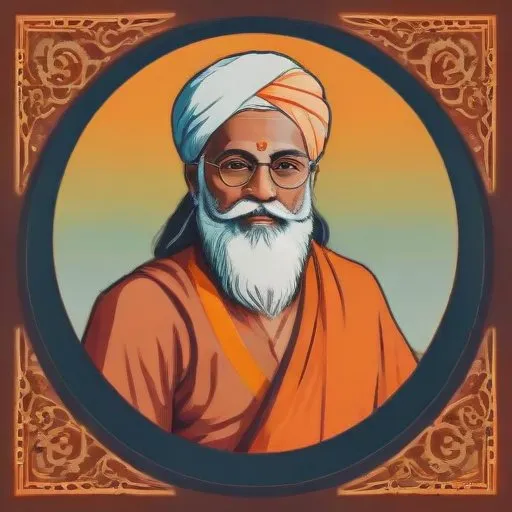
A renowned Indian spiritual guru and educator who popularized the teachings of Vedanta, a philosophy that emphasizes self-realization and spiritual growth, through his writings, lectures, and institutions.
Chinmayananda Saraswati was a renowned Hindu spiritual leader, teacher, and philosopher who founded the Chinmaya Mission, a global nonprofit organization dedicated to spreading the knowledge of Advaita Vedanta, the Bhagavad Gita, and other ancient Hindu scriptures. Through his mission, he spearheaded a global Hindu spiritual and cultural renaissance, popularizing these spiritual texts and values through his teachings in English across India and abroad.
Born Balakrishna Menon on May 8, 1916, Chinmayananda was originally a journalist and participated in the Indian independence movement. However, his spiritual journey began under the tutelage of Swami Sivananda and later Tapovan Maharaj, where he studied Vedanta and took the vow of sannyasa.
In 1951, Chinmayananda gave his first jnana yajna, or lecture series, marking the beginning of the Chinmaya Mission. Today, the mission encompasses over 300 centers in India and internationally, conducting educational, spiritual, and charitable activities. Chinmayananda's approach was characterized by an appeal to the English-educated Indian middle class and Indian diaspora, breaking down cultural and linguistic barriers to spread Hindu spirituality.
Chinmayananda's philosophical contributions were rooted in his deep understanding of Advaita Vedanta, which he believed was the essence of Hinduism. He emphasized the importance of self-realization, self-inquiry, and the pursuit of spiritual knowledge. His teachings were marked by simplicity, clarity, and relevance to modern life, making him a beloved guru to millions.
Chinmayananda authored 95 publications, including commentaries on the major Upanishads and Bhagavad Gita. Some of his notable works include:
Chinmayananda's impact on modern society is multifaceted. He helped found the Vishva Hindu Parishad (VHP), an Indian right-wing Hindu organization, and convened its first meeting in 1964. His mission also conducts various charitable and educational activities, promoting social welfare and community development.
Chinmayananda Saraswati's legacy continues to inspire generations of spiritual seekers, philosophers, and scholars. His mission remains a beacon of hope, promoting Hindu spiritual and cultural values globally. His life's work serves as a testament to the power of self-realization, self-inquiry, and the pursuit of spiritual knowledge.
Chinmayananda Saraswati's life and work must be understood within the context of India's struggle for independence and the subsequent era of national reconstruction. His mission and teachings drew parallels with other prominent Indian gurus, such as Swami Vivekananda and Swami Sivananda, who also sought to popularize Hindu spirituality globally.
Chinmayananda Saraswati's relationships with his disciples and followers were marked by warmth, compassion, and wisdom. His ashram at Piercy, California, remains a testament to his connection with the global Hindu community.
Chinmayananda Saraswati's teachings and mission have inspired various artistic and cultural expressions, including music, dance, and literature. His legacy continues to influence contemporary Indian thought and culture.
Chinmayananda Saraswati's life is a testament to the power of self-realization, perseverance, and dedication. His teachings continue to inspire millions, emphasizing the importance of spiritual growth, self-inquiry, and service to humanity.
As we reflect on the life and legacy of Chinmayananda Saraswati, we are reminded of the profound impact one individual can have on society. His mission, teachings, and legacy serve as a beacon of hope, guiding us towards a path of spiritual growth, self-realization, and service to humanity.
Born in 1863
A key figure in introducing Indian philosophies to the Western world, he's known for his inspiring lectures and writings on spirituality, self-realization, and the unity of all religions.
Born in 1853
A spiritual leader and wife of Ramakrishna, known for her teachings on spirituality, self-realization, and women's empowerment. Her wisdom and compassion inspired many, especially women, to seek spiritual growth.
Born in 1893
An Indian-American spiritual leader who introduced millions to meditation and Eastern thought through his writings and teachings, most notably the bestselling book "Autobiography of a Yogi".
Born in 1872
An Indian spiritual leader who developed a philosophy of integral yoga, aiming to unite spiritual growth with worldly life, and wrote extensively on spirituality, philosophy, and poetry.
Born in 1879
A revered Indian sage who advocated for self-inquiry and non-dualism, guiding seekers towards spiritual liberation through direct experience of the ultimate reality.
Born in 1897
A renowned Indian sage and guru, he is most known for his teachings on non-dualism and the attainment of self-realization through direct experience and inquiry.
