


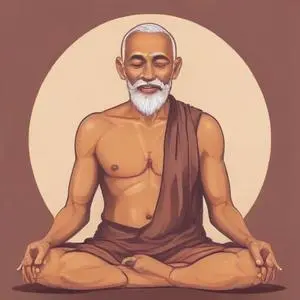
A revered Indian sage who advocated for self-inquiry and non-dualism, guiding seekers towards spiritual liberation through direct experience of the ultimate reality.
Ramana Maharshi, born Venkataraman Iyer, was a renowned Indian Hindu sage and jivanmukta (liberated being) who exemplified self-realization and spiritual awakening. He is revered for his profound teachings on self-enquiry, non-dualism, and the pursuit of true self-awareness.
Ramana Maharshi was born on December 30, 1879, in Tiruchuli, Tamil Nadu, India, to an orthodox Hindu Brahmin family. His early life was marked by a spark of spiritual curiosity, which intensified at the age of 16 when he experienced a profound "death-experience." This transformative event awakened him to the recognition of his true self, which he later identified with the personal God, or Iswara (Shiva).
In 1895, Ramana Maharshi felt an inexplicable attraction to the sacred hill Arunachala and the 63 Nayanmars, a group of revered Tamil saints. This calling led him to leave his uncle's home in Madurai and journey to Tiruvannamalai, where he took on the role of a sannyasin (renunciate) and remained for the rest of his life.
Ramana Maharshi's teachings emphasized the importance of self-enquiry (atma-vichara) as the principal means to remove ignorance and abide in self-awareness. He advocated for the practice of bhakti (devotion) or surrender to the Self, which he believed would lead individuals to a state of liberation. His philosophy was deeply rooted in non-dualism, emphasizing the unity and oneness of all existence.
Ramana Maharshi's teachings have had a profound impact on modern spirituality, attracting devotees and seekers from around the world. His ashram, established in Tiruvannamalai, has become a hub for spiritual seekers, offering guidance and instruction through sitting silently in his company or by asking questions. His teachings have been popularized in the West since the 1930s, inspiring countless individuals on the path to self-discovery and enlightenment.
Ramana Maharshi's teachings have influenced numerous spiritual leaders, philosophers, and writers, including Eckhart Tolle, J. Krishnamurti, and Aldous Huxley. His philosophy has also inspired various spiritual movements, such as the Advaita Vedanta tradition, and continues to inspire contemporary spiritual seekers.
Ramana Maharshi's remarkable life and teachings continue to inspire and guide those seeking spiritual awakening and self-realization. His legacy serves as a beacon of hope, illuminating the path to true self-awareness and liberation.
Born in 1872
An Indian spiritual leader who developed a philosophy of integral yoga, aiming to unite spiritual growth with worldly life, and wrote extensively on spirituality, philosophy, and poetry.
Born in 1863
A key figure in introducing Indian philosophies to the Western world, he's known for his inspiring lectures and writings on spirituality, self-realization, and the unity of all religions.
Born in 1888
An Indian philosopher and politician who served as the 2nd President of India, known for his influential writings on Indian philosophy and his role in shaping India's education system.
Born in 1869
Indian freedom fighter, activist, and philosopher who led India to independence from British rule through non-violent civil disobedience, inspiring civil rights movements worldwide.
Born in 1895
A spiritual teacher who traveled the world giving talks and lectures on the nature of the self, consciousness, and the human condition, advocating for a path of self-inquiry and inner transformation.
Born in 1897
A renowned Indian sage and guru, he is most known for his teachings on non-dualism and the attainment of self-realization through direct experience and inquiry.
