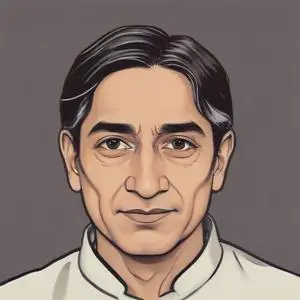
Jiddu Krishnamurti: The Philosopher of Freedom and Choiceless Awareness
A Life Dedicated to Spiritual Inquiry and Self-Discovery
Jiddu Krishnamurti, a renowned Indian philosopher, speaker, and writer, is best known for his unconventional and thought-provoking ideas on spiritual growth, self-awareness, and the nature of the human condition. Throughout his life, he rejected the notion of authority and spiritual hierarchies, instead, emphasizing the importance of individual freedom and choiceless awareness in the pursuit of truth.
A Turbulent Childhood and the Seeds of Spiritual Inquiry
Born on May 11, 1895, in Madanapalle, India, Krishnamurti's early life was marked by turmoil and uncertainty. His father, Jiddu Narayanaiah, a Theosophical Society member, believed his son to be the reincarnation of a high-ranking spiritual being, destined to become the World Teacher. However, Krishnamurti would later reject this label, forging his own path and developing a distinct philosophical framework.
The Rejection of Authority and the Emergence of a Unique Philosophy
Krishnamurti's philosophical contributions were characterized by a rejection of authority, tradition, and spiritual dogma. He believed that truth could not be found through external means, such as gurus, scriptures, or institutions, but rather through individual self-inquiry and awareness. His teachings emphasized the importance of psychological freedom, unconditioned thinking, and the need to question all assumptions and beliefs.
Life's Work and Major Publications
Throughout his life, Krishnamurti wrote extensively on his philosophical ideas, publishing numerous books, including
The First and Last Freedom (1954) and
Commentaries on Living (1956-1960). He also engaged in public talks and dialogues, many of which were recorded and later published. These works continue to be widely read and studied today, offering insights into his unique perspective on the human condition.
Influence on Modern Society and Education
Krishnamurti's ideas have had a profound impact on modern society, influencing fields such as education, psychology, and spirituality. His approach to education, which emphasizes the importance of self-awareness, critical thinking, and emotional intelligence, has inspired the establishment of several schools and educational institutions around the world.
Personal Milestones and Key Life Events
- 1929: Krishnamurti's rejection of the role of World Teacher and his subsequent disassociation from the Theosophical Society.
- 1930s-1950s: Extensive global travels, engaging in public talks and dialogues.
- 1954: Publication of The First and Last Freedom, a seminal work outlining his philosophical framework.
- 1960s-1980s: Continued writing, speaking, and teaching, with a focus on the importance of individual freedom and self-awareness.
- 1986: Krishnamurti's final public talk, followed by his passing on February 17, 1986, at the age of 90.
Quotes and Memorable Sayings
- "Truth is a pathless land."
- "The highest form of intelligence is the ability to observe yourself without judgment."
- "You can't bring about a change in the world by changing the outward circumstances; you can only bring about a change in the world by changing yourself."
Legacy and Historical Context
Krishnamurti's life and work have left an indelible mark on the spiritual and philosophical landscape. His ideas, though often unconventional and provocative, have inspired generations of thinkers, educators, and seekers of truth. As a testament to his lasting impact, his teachings continue to be studied, debated, and practiced around the world, offering a beacon of hope for those seeking a more authentic, self-aware, and compassionate way of living.
FAQ
What was Jiddu Krishnamurtis philosophy of life?
Jiddu Krishnamurti was a philosopher and spiritual teacher who advocated for a radical approach to living, emphasizing the importance of individual freedom, self-awareness, and the transformation of human consciousness.
What was Jiddu Krishnamurtis relationship like with the Theosophical Society?
Jiddu Krishnamurti was discovered as a young man by the Theosophical Society, which believed him to be the prophesied World Teacher, but he later distanced himself from the organization and developed his own independent philosophy.
What were Jiddu Krishnamurtis views on education?
Jiddu Krishnamurti was a strong critic of traditional education, advocating instead for a more holistic and compassionate approach that emphasizes the development of the whole person.
How did Jiddu Krishnamurti influence modern spirituality?
Jiddu Krishnamurtis teachings have had a profound impact on modern spirituality, inspiring a wide range of spiritual seekers and thinkers and influencing the development of contemporary spiritual movements.
What legacy did Jiddu Krishnamurti leave behind?
Jiddu Krishnamurti left behind a legacy as a visionary philosopher and spiritual teacher, remembered for his innovative and provocative ideas about the human condition and the nature of reality.