


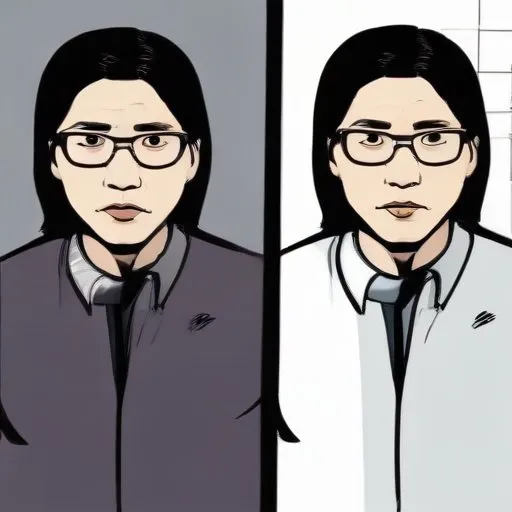
Developed influential theories on algebraic geometry and number theory, making significant contributions to the field of mathematics.
Chiungtze C. Tsen, a renowned Chinese mathematician, is best known for his groundbreaking work in algebra, particularly in the area of quasialgebraic closure. His fundamental result, now famously referred to as Tsen's theorem, has left an indelible mark on the field of mathematics.
Born on April 2, 1898, in Nanchang, Jiangxi, China, Tsen grew up in a poor fisherman's family. Despite the financial struggles, his uncle Lei Heng, a respected jinshi and member of the Hanlin Academy, recognized Tsen's potential and encouraged his father to send him to school.
Tsen's educational journey was marked by interruptions due to poverty, forcing him to work in a coal mine while self-studying. However, his perseverance paid off when he passed the entrance examination and was admitted to Jiangxi Provincial First Normal College in Nanchang in 1917.
After graduating in 1920, Tsen taught in primary school for two years before entering National Wuchang Senior Normal College (later National Wuchang University) to study undergraduate mathematics. He graduated in 1926 and worked as a high school teacher for two years to fulfill his degree's mandatory teaching service.
In 1927, Tsen's passion for social justice led him to protest against the split between the Kuomintang and the Chinese Communist Party, along with some teachers and students. Unfortunately, this activism resulted in him being beaten up and hospitalized.
Tsen's work in algebra, particularly in quasialgebraic closure, has been instrumental in shaping the field of mathematics. His theorem, which bears his name, has become a fundamental concept in modern algebra.
As one of Emmy Noether's students at the University of Göttingen, Germany, Tsen was heavily influenced by her ideas and principles. His research interests were vast, ranging from algebraic geometry to number theory.
Chiungtze C. Tsen's contributions to mathematics have had a lasting impact on the field. His work has inspired generations of mathematicians, and his theorem remains a cornerstone of algebraic research.
Despite his untimely passing on October 1, 1940, Tsen's legacy continues to inspire and influence mathematicians worldwide. His story serves as a testament to the power of perseverance, passion, and dedication to one's craft.
Born in 1912
A pioneering experimental physicist who disproved a fundamental concept in physics, the law of parity, and made groundbreaking contributions to particle physics.
99 Years Old
A Chinese-American physicist and academic who won the Nobel Prize for his work on the parity non-conservation of weak interactions, revolutionizing our understanding of particle physics.
Born in 1922
A renowned physicist who made groundbreaking contributions to our understanding of subatomic particles, earning a Nobel Prize for his work on parity non-conservation.
99 Years Old
Pioneering astrophysicist who discovered the solar wind and its impact on the solar system, revolutionizing our understanding of space and the sun's influence.
Born in 1910
A renowned scientist who pioneered our understanding of black holes and the behavior of stars, earning a Nobel Prize in Physics in 1983.
87 Years Old
A mathematician, astronomer, and biologist who proposed the theory of panspermia, suggesting that life on Earth originated from outer space, and made significant contributions to astrobiology and the search for extraterrestrial life.
