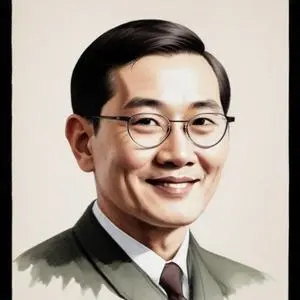
Chen-Ning Yang: The Theoretical Physicist Who Redefined Symmetry
A Brief Introduction to a Revolutionary Mind
Chen-Ning Yang, a Chinese-American theoretical physicist, is renowned for his groundbreaking contributions to the field of particle physics, particularly his pioneering work on parity non-conservation and the concept of CP symmetry. His Nobel Prize-winning research, conducted in collaboration withTsung-Dao Lee, has had a profound impact on our understanding of the fundamental laws of nature.
Early Life and Education
Born on September 22, 1922, in Hofei, Anhui, China, Yang's fascination with science was ignited at an early age. He pursued his undergraduate studies at the National Southwestern Associated University in Kunming, China, before moving to the United States in 1945 to continue his graduate studies at the University of Chicago. Under the guidance of renowned physicist
Enrico Fermi, Yang earned his Ph.D. in 1948.
Theoretical Breakthroughs and Nobel Laureate
Yang's most significant contribution to physics lies in his work on parity non-conservation, which challenged the long-held assumption of left-right symmetry in physical laws. His 1956 paper, co-authored with
Tsung-Dao Lee, proposed that parity was not conserved in weak interactions, a theory that was later experimentally confirmed. This revolutionary idea earned Yang and Lee the Nobel Prize in Physics in 1957.
Philosophical Contributions and Beliefs
Yang's work has far-reaching implications for our understanding of the universe, shedding light on the nature of reality and the laws that govern it. His research has sparked philosophical debates on the concept of symmetry, encouraging a reevaluation of the fundamental principles of physics. Yang's own philosophical stance emphasizes the importance of theoretical rigor and experimentation in scientific inquiry.
Career Highlights and Major Works
Yang's illustrious career spans over six decades, marked by numerous achievements and prestigious appointments. Some of his notable works include:
- Co-authorship of the seminal paper "Question of Parity Conservation in Weak Interactions" (1956)
- Publication of the influential textbook "Elementary Particles and Quantum Field Theory" (1962)
- Professorship at the State University of New York at Stony Brook (1966-1999)
- Directorship of the Institute of Theoretical Physics at Stony Brook (1966-1997)
Influence on Modern Society and Pop Culture
Yang's work has transcended the realm of academia, inspiring artistic and cultural expressions. His concept of symmetry has been applied in various fields, from architecture to music, and has influenced the works of artists, writers, and filmmakers.
Awards and Honors
Yang's contributions to physics have been recognized with numerous accolades, including:
Legacy and Historical Context
Yang's paradigm-shifting research has left an indelible mark on the field of physics, redefining our understanding of the universe and its underlying laws. His work continues to influence contemporary research, shaping the course of modern physics and inspiring future generations of scientists.
Comparative Analysis with Contemporaries
Yang's contributions can be contextualized within the broader landscape of 20th-century physics, alongside pioneers like
Richard Feynman,
Julian Schwinger, and
Murray Gell-Mann. His work shares similarities with that of Tsung-Dao Lee, his collaborator and fellow Nobel laureate, and underscores the importance of collaboration in scientific discovery.
Personal Milestones and Key Life Events
Yang's life has been marked by significant personal milestones, including:
- Naturalization as a United States citizen (1964)
- Marriage to Chih-Li Tu (1950)
- Fatherhood of two children, Emily and Franklin
Quotes and Memorable Sayings
Yang's words of wisdom continue to inspire scientists and thinkers alike:
- "Theoretical physics is a rich and beautiful field, full of subtle and intriguing problems."
- "The most important thing in science is not to be afraid to be wrong."
Trivia and Fun Facts
Yang's life is filled with interesting anecdotes and lesser-known facts:
- He was an avid reader of classical Chinese literature and poetry.
- Yang was a talented pianist and enjoyed playing Chopin's nocturnes.
Conclusion
Chen-Ning Yang's remarkable journey has left an indelible mark on the world of physics, inspiring generations of scientists and thinkers. His groundbreaking research, philosophical contributions, and personal achievements have cemented his place as one of the most influential physicists of the 20th century. As we continue to explore the intricacies of the universe, Yang's legacy serves as a beacon, guiding us toward a deeper understanding of the fundamental laws that govern our reality.
FAQ
What was Chen-Ning Yangs most significant scientific contribution?
Chen-Ning Yangs most significant scientific contribution was his work on the Yang-Mills theory, a fundamental concept in particle physics that describes the strong and weak nuclear forces. He was awarded the Nobel Prize in Physics in 1957 for this work.
How did Chen-Ning Yangs research impact our understanding of subatomic particles?
Chen-Ning Yangs research, particularly his work on parity non-conservation, revolutionized our understanding of subatomic particles and the fundamental forces of nature. His work led to a deeper understanding of the structure of matter and the universe.
What was Chen-Ning Yangs early life and education like?
Chen-Ning Yang was born in China and grew up in a family of intellectuals. He studied at the National Southwestern Associated University and later earned his Ph.D. from the University of Chicago.
What awards did Chen-Ning Yang receive for his scientific contributions?
Chen-Ning Yang received numerous awards for his scientific contributions, including the Nobel Prize in Physics, the National Medal of Science, and the Albert Einstein Award.
What is Chen-Ning Yangs legacy in physics?
Chen-Ning Yangs legacy is that of a pioneering physicist who made groundbreaking contributions to our understanding of the fundamental forces of nature. He remains one of the most important physicists of the 20th century.