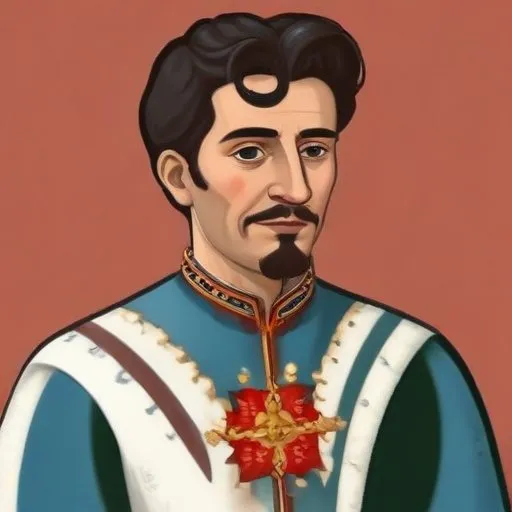
Christopher of Bavaria: The Unifying King of the North
A King of Three Realms
Christopher of Bavaria, also known as Christopher III of Denmark, Sweden, and Norway, was a remarkable leader who united the Scandinavian kingdoms under one crown during the era of the Kalmar Union. Born on February 26, 1416, Christopher was destined to play a significant role in shaping the course of Scandinavian history.
Rise to Power
The son of John, Count Palatine of Neumarkt, and Catherine of Pomerania, Christopher's lineage was marked by royal connections. His mother, Catherine, was the sister of Eric of Pomerania, the Scandinavian king, and his father was a son of King
Rupert of Germany. This royal heritage paved the way for Christopher's ascension to the throne.
King of Denmark, Sweden, and Norway
In 1439, Eric of Pomerania was deposed, and Christopher was elected as his successor by the Danish State Council. Initially, he served as regent, but soon he was proclaimed King of Denmark at the Viborg Assembly in 1440. His ability to navigate the complexities of Scandinavian politics led to his election as King of Sweden in 1441 and King of Norway in 1442.
A Unifying Leader
Christopher's vision was to create a unified empire, rather than separate kingdoms. He adopted the title of "arch king" (archirex) to reflect his ambition to rule an empire, rather than individual countries. This vision was unprecedented, as it aimed to bring stability and cohesion to the region.
Challenges and Achievements
Christopher faced numerous challenges during his reign, including peasant rebellions in Funen, which he effectively put down. He was also known for his efforts to strengthen the royal power, which had been weakened by the nobility. Despite these challenges, Christopher managed to maintain a balance between royal power and nobility, a feat that would shape the course of Scandinavian history for centuries to come.
Personal Life and Legacy
Christopher married Dorothea of Brandenburg in 1445, and although they had no children, his legacy lived on. He died on January 5, 1448, but his impact on Scandinavian history remains significant. His reign marked the beginning of a period of balance between royal power and nobility, which lasted until 1660.
- Name: Christopher of Bavaria, also known as Christopher III of Denmark, Sweden, and Norway
- Born: February 26, 1416
- Died: January 5, 1448
- King of Denmark, Sweden, and Norway; Arch King (Archirex)
- Marriage: Dorothea of Brandenburg (1445)
Historical Context and Legacy
Christopher's reign marked a significant turning point in Scandinavian history. His vision of a unified empire and his efforts to balance royal power and nobility had a lasting impact on the region. Today, he is remembered as a unifying leader who played a crucial role in shaping the course of Scandinavian history.
FAQ
Who was Christopher of Bavaria?
Christopher of Bavaria was King of Denmark, Norway, and Sweden from 1440 to 1448. He was a member of the House of Wittelsbach and played a significant role in Scandinavian politics during the 15th century.
What were Christopher of Bavarias accomplishments as king?
Christopher of Bavaria strengthened the economies of Denmark, Norway, and Sweden, and promoted trade and commerce. He also reformed the government and improved the administration of justice.
What was Christopher of Bavarias role in the Kalmar Union?
Christopher of Bavaria was a key figure in the Kalmar Union, a union of Denmark, Norway, and Sweden that aimed to promote cooperation and stability in the region.
How did Christopher of Bavaria die?
Christopher of Bavaria died on January 5, 1448, likely due to the plague or a heart condition. He was succeeded by Christian I of Denmark, who became the King of Denmark, Norway, and Sweden.
What was Christopher of Bavarias legacy?
Christopher of Bavarias legacy is complex, with some historians viewing him as a strong leader who promoted stability and cooperation, while others see him as a ruler who prioritized his own interests and power.