


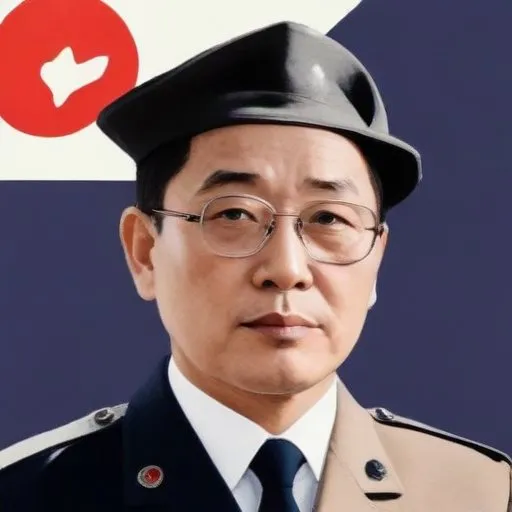
A South Korean politician, diplomat, and soldier who served as the Prime Minister of South Korea from 1964 to 1970 and played a key role in shaping the country's modernization and economic development.
Chung Ilkwon, a South Korean politician, diplomat, and soldier, left an indelible mark on the country's history. As a general in the Republic of Korea Army, he served as Foreign Minister from 1963 to 1964 and later as Prime Minister from 1964 to 1970, earning the trust of President Park Chung Hee.
Born on November 21, 1917, in Ussuriysk, Russia, Chung's life was shaped by the tumultuous landscape of Korean history. His father, an interpreter for the Imperial Russian Army, relocated the family to Kyongwon County, Korea, in 1917, only to move again to Yanbian Korean Autonomous Prefecture in Manchuria in 1930. It was here that Chung grew up in extreme poverty, adopting the Japanese name Ikken Nakashima during the Japanese occupation of Korea.
Chung's academic prowess earned him a place at the Manchukuo Imperial Army academy in Mukden, from which he graduated in September 1937. He further honed his skills at the Imperial Japanese Army Academy in Tokyo, specializing in cavalry operations. During the Pacific War, he served as a military police captain in the Manchukuo Imperial Army.
Following the Soviet invasion of Manchuria, Chung was briefly captured by Soviet forces and interrogated by the KGB. After his release, he graduated from the first class of the Korea Military Academy in 1946 and was commissioned into the South Korean army. During the Korean War, he arrived in Korea on June 30, 1950, and was immediately promoted to major general, replacing General Chae Byongduk as commander of the Republic of Korea Army.
Chung's diplomatic acumen and military prowess propelled him to the forefront of South Korean politics. As Foreign Minister from 1963 to 1964, he played a crucial role in shaping the country's foreign policy. His success in this role led to his appointment as Prime Minister, a position he held from 1964 to 1970. During his tenure, he worked closely with President Park Chung Hee to modernize the country's economy and strengthen its international relations.
Chung's commitment to his country and its people was unwavering. He believed in the importance of a strong military and a robust economy in ensuring national sovereignty. His leadership style was marked by a strong sense of discipline and responsibility, earned from his experience in the military.
Chung Ilkwon's legacy extends far beyond his political and military achievements. He played a pivotal role in shaping South Korea's modern identity and its place on the global stage. As a testament to his enduring impact, he remains an inspiration to generations of Koreans, a symbol of patriotism, duty, and integrity.
Born in 1924
A South Korean politician and Nobel laureate who served as the country's 8th president, known for his Sunshine Policy towards North Korea and efforts to promote democracy and human rights. He is a symbol of South Korea's transition from dictatorship to democracy.
93 Years Old
South Korea's first democratically elected president, known for his role in the country's transition to democracy and his key role in the 1988 Seoul Olympics. He's also infamous for his involvement in a military coup and human rights abuses.
95 Years Old
A South Korean general and politician who served as the 5th President of South Korea, known for his military coup and subsequent authoritarian rule. He's infamous for his role in the Gwangju Democratization Movement's brutal suppression.
98 Years Old
The 7th President of South Korea, a key figure in the country's democratization, known for his efforts to reform the government and economy. He's also remembered for his "New Economy" plan and anti-corruption initiatives.
84 Years Old
South Korea's first businessman president, known for his economic reforms and infrastructure projects, particularly the Four Major Rivers Project. He was also involved in a corruption scandal that led to his imprisonment.
74 Years Old
The first female president of South Korea, serving from 2013 to 2017, known for her efforts to improve relations with North Korea and her subsequent impeachment and imprisonment for corruption.
73 Years Old
The 19th President of South Korea, a key figure in the country's efforts to reconcile with North Korea, known for his progressive policies and Nobel Peace Prize nomination.
