


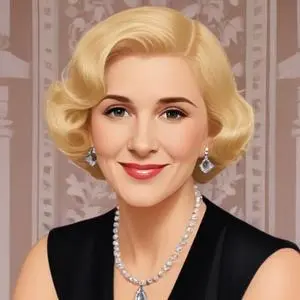
A trailblazing woman who excelled in multiple fields, penning hit plays, reporting on politics, and serving as a diplomat, leaving a lasting mark on American culture and international relations.
Meet Clare Boothe Luce, the trailblazing American writer, politician, U.S. ambassador, and public figure who left an indelible mark on the world with her work. She is best known for her groundbreaking 1936 play, The Women, which boasted an all-female cast, and her diverse writings that spanned drama, screen scenarios, fiction, journalism, and war reportage.
Luce's life was a testament to her boundless energy, creativity, and passion for making a difference. Born Ann Clare Boothe on March 10, 1903, in New York City, she grew up in a family that encouraged her love of literature. Her father, William Franklin Boothe, a talented violinist, instilled in her a love of literature, which would become a cornerstone of her life's work.
Luce's writing career took off early, with her first play, Abide with Me, being produced in 1935. The following year, her hit play, The Women, debuted on Broadway, cementing her reputation as a talented and innovative playwright. In 1935, she married Henry Luce, the publisher of Time, Life, Fortune, and Sports Illustrated, a union that would last until his death in 1967.
The Women, Luce's most celebrated play, was a groundbreaking work that featured an all-female cast, including celebrities like Norma Shearer, Joan Crawford, and Paulette Goddard. The play's success can be attributed to Luce's witty dialogue, sharp characterizations, and insightful commentary on women's lives during the 1930s. The play's themes of female friendship, love, and social status continue to resonate with audiences today.
Luce's work was recognized with numerous awards and honors, including three Academy Award nominations for her screenwriting work on films like Kiss the Boys Goodbye (1941) and Come to the Stable (1949). Her literary contributions earned her a place in the American Theater Hall of Fame in 1981.
In the 1940s, Luce's political leanings shifted from liberal to conservative, and she became a vocal critic of President Franklin D. Roosevelt's New Deal policies. Her strong anticommunist stance led her to support Republican presidential candidates, including Wendell Willkie, Dwight D. Eisenhower, and Ronald Reagan. In 1953, President Eisenhower appointed her as the U.S. Ambassador to Italy, a position she held until 1956.
Clare Boothe Luce's life was a testament to the power of hard work, determination, and creativity. Through her writing, politics, and diplomacy, she left an indelible mark on American culture and society. Her legacy continues to inspire generations of women and men, encouraging them to pursue their passions and make a difference in the world.
Today, Clare Boothe Luce's remarkable life and achievements serve as a beacon of inspiration, reminding us that with dedication, perseverance, and a willingness to take risks, we can overcome obstacles and achieve greatness.
Born in 1893
A witty and insightful writer who crafted poetry, short stories, and critiques that continue to delight readers with their clever wordplay and sharp observations.
Born in 1896
Acclaimed playwright and screenwriter behind iconic films like "Rebecca" and "The Best Years of Our Lives", earning him three Academy Awards and a Pulitzer Prize.
Born in 1887
A renowned theater critic and member of the Algonquin Round Table, known for his sharp wit and acerbic reviews that could make or break a Broadway show.
Born in 1872
American journalist and art and theatre critic who championed modern art and avant-garde theatre, introducing Americans to European modernism. He was the first editor of Vanity Fair magazine.
Born in 1884
Witty writer and Washington socialite, known for her sharp tongue and humorous writings that skewered politics and high society.
Born in 1884
A humanitarian and politician who championed human rights, women's empowerment, and social justice, leaving a lasting impact on American politics and international relations.
Born in 1882
Led the United States through the Great Depression and World War II, implementing a series of reforms known as the New Deal and helping to establish the country as a global superpower.
Born in 1884
The 33rd President of the United States, a strong leader who made tough decisions, including dropping atomic bombs on Japan and establishing the Marshall Plan to rebuild Europe after WWII.
