


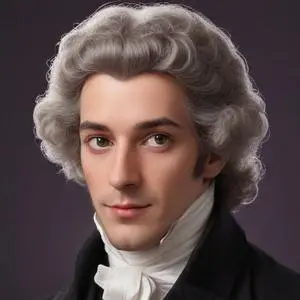
A French chemist and academic who pioneered the discovery of chlorine and developed a new theory of chemical reactions, revolutionizing the field of chemistry.
Claude Louis Berthollet, a renowned Savoyard-French chemist, is celebrated for his groundbreaking contributions to the theory of chemical equilibria via the mechanism of reverse chemical reactions, as well as his significant role in shaping modern chemical nomenclature.
Moreover, Berthollet is credited with being the first to demonstrate the bleaching action of chlorine gas and developing a solution of sodium hypochlorite as a modern bleaching agent, revolutionizing the textile industry.
Claude Louis Berthollet was born on December 9, 1748, in Talloires, near Annecy, in the Duchy of Savoy.
He began his studies at Chambéry and later pursued his education in Turin, where he graduated in medicine.
Berthollet's exceptional contributions to chemistry earned him a prestigious position at the Academy of Science in 1780, where he collaborated with Antoine Lavoisier and other prominent chemists to devise a systematic nomenclature for chemicals.
This groundbreaking work laid the foundation for the modern system of naming chemical compounds, ensuring consistency and clarity in chemical communication.
Berthollet's research interests extended to dyes and bleaches, leading to the introduction of chlorine gas as a commercial bleach in 1785.
In 1789, he produced a modern bleaching liquid, known as Eau de Javel, by passing chlorine gas through a solution of sodium carbonate in his laboratory on the quay Javel in Paris, France.
This innovation led to the development of sodium hypochlorite, a weak solution of potassium chlorate, now recognized as Berthollet's Salt.
Berthollet was one of the first chemists to recognize the characteristics of a reverse reaction, paving the way for the concept of chemical equilibrium.
His pioneering work in this area enabled him to determine the elemental composition of the gas ammonia in 1785, a significant milestone in the history of chemistry.
Berthollet's contributions to chemistry have had a profound impact on the development of modern chemistry, influencing generations of chemists and scientists.
His work on chemical nomenclature and equilibria has been instrumental in shaping the language and principles of chemistry, ensuring a solid foundation for ongoing research and discovery.
In recognition of his outstanding achievements, Berthollet was appointed as the Vice President of the French Senate in 1804, a testament to his esteemed reputation in the scientific community.
Berthollet's remarkable legacy continues to inspire scientists, educators, and researchers, ensuring his place as one of the most influential chemists in history.
Born in 1743
Father of modern chemistry, discovered oxygen, and developed a systematic method of chemical nomenclature. He laid the foundation for modern chemistry and paved the way for future scientific discoveries.
Born in 1742
A pioneering pharmaceutical chemist who discovered oxygen, chlorine, and other elements, and made significant contributions to the field of chemistry.
Born in 1778
Pioneering chemist and physicist who discovered several elements, including potassium and sodium, and invented the Davy lamp, a safety lamp for miners. His groundbreaking work laid the foundation for modern chemistry and electrochemistry.
82 Years Old
A British bassist who played with bands like The Levellers and Faithless, known for his energetic stage presence and distinctive bass lines.
Born in 1776
Formulated the molecular hypothesis, which states that equal volumes of gases at the same temperature and pressure contain an equal number of molecules. This concept is fundamental to understanding chemistry and physics.
Born in 1749
Developed nebular hypothesis of the origin of the solar system and formulated Laplace's equation, a fundamental concept in mathematics and physics. He's considered the founder of celestial mechanics.
Born in 1728
Discovered magnesium and isolated carbon dioxide, making significant contributions to the field of chemistry.
