


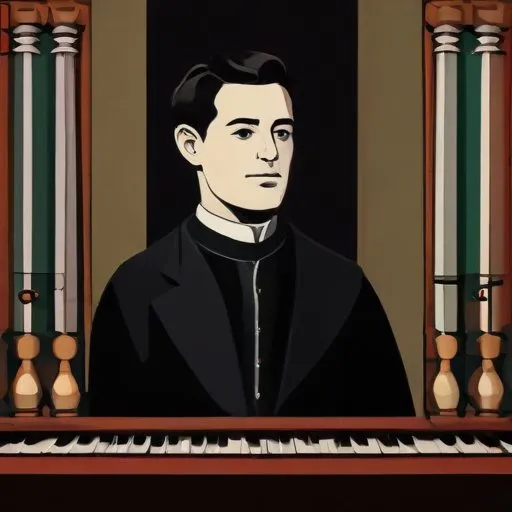
A renowned 16th-century organist and composer, known for his innovative and expressive organ music, particularly in the Venetian School style. His works showcased remarkable technical skill and emotional depth.
Claudio Merulo, a renowned Italian composer, publisher, and organist, is celebrated for his groundbreaking contributions to the late Renaissance period. His innovative keyboard music and ensemble compositions in the Venetian polychoral style have left an indelible mark on the world of music.
Born Claudio Merlotti on April 8, 1533, in Correggio, Italy, Merulo later Latinized his surname to mean "little blackbird" as he gained fame in Venetian cultural circles. Although little is known about his early life, it is documented that he studied with Tuttovale Menon, a prominent madrigalist, and Girolamo Diruta, an accomplished organist. It is also likely that he received training from the illustrious Zarlano at St. Mark's in Venice.
Merulo's exceptional talent as an organist earned him the appointment as organist at the Old Cathedral of Brescia (Duomo Vecchio) on October 21, 1556. Just a year later, he secured the prestigious position of organist at St. Mark's in Venice, outshining a pool of talented candidates, including Andrea Gabrieli. This marked a significant milestone in his career, solidifying his reputation as the finest organist in Italy.
In 1557, Merulo was appointed to the second, smaller organ at St. Mark's, with Annibale Padovano serving as the first organist. Following Padovano's sudden departure in 1566, Merulo took over as the first organist, with Andrea Gabrieli succeeding him as the second organist.
In 1579, Merulo served as an ambassador for the Venetian Republic during the marriage of Francesco de' Medici and Bianca Cappello, and composed music for the celebration. He also wrote music for Henry III of France during his visit to Venice in 1574.
In 1584, Merulo mysteriously left his position at St. Mark's, with the reasons for his departure remaining unclear. Despite this, his legacy as a pioneering composer and organist endures, leaving an indelible mark on the world of music.
Merulo's friendship with Costanzo Porta, a fellow composer, lasted a lifetime. The two shared a deep bond, with Porta often seeking Merulo's counsel and guidance. Their friendship serves as a testament to Merulo's kindness, generosity, and dedication to his craft.
Merulo's innovative compositions and masterful organ playing paved the way for future generations of musicians. His contributions to the development of the Venetian polychoral style continue to inspire and influence contemporary composers and musicians.
Although there are no recorded quotes from Merulo, his music speaks volumes about his passion, creativity, and dedication to his craft. His compositions remain a testament to his eternal legacy, inspiring future generations to create, innovate, and push the boundaries of musical expression.
Merulo's life and work are a reflection of the cultural and artistic ferment of the late Renaissance period. His compositions, steeped in the Venetian polychoral style, continue to captivate audiences today, offering a glimpse into the rich cultural heritage of 16th-century Italy.
| 1533 | Born Claudio Merlotti in Correggio, Italy |
| 1556 | Appointed organist at Old Cathedral of Brescia (Duomo Vecchio) |
| 1557 | Appointed organist at St. Mark's in Venice |
| 1566 | Becomes first organist at St. Mark's |
| 1574 | Composes music for Henry III of France's visit to Venice |
| 1579 | Serves as ambassador for Venetian Republic during the marriage of Francesco de' Medici and Bianca Cappello |
| 1584 | Departure from St. Mark's |
| 1604 | Dies in Parma, Italy |
Claudio Merulo's life, marked by innovation, creativity, and passion, continues to inspire and captivate audiences today. His legacy, woven into the fabric of music history, remains an eternal testament to the power of art to transcend time and touch the human heart.
Born in 1567
A Baroque music pioneer who revolutionized the opera and sacred music genres with innovative harmonies and orchestration, leaving an indelible mark on classical music.
Born in 1585
A renowned Baroque composer and organist, known for his contributions to the development of the oratorio and passion genres, creating over 500 works that showcased his mastery of choral music.
Born in 1568
A renowned Baroque-era organist and composer, known for his innovative and influential contributions to the development of the concerto grosso and oratorio genres.
