


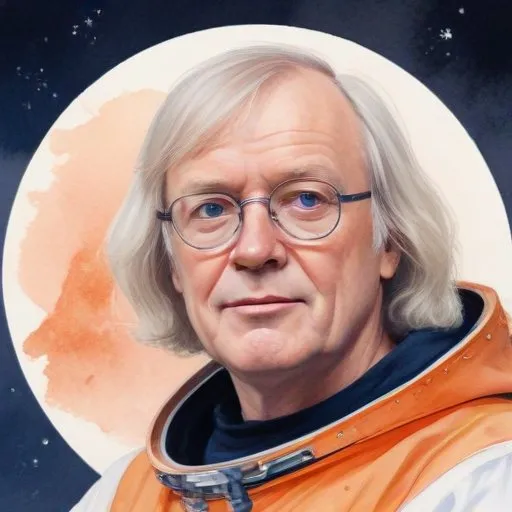
A renowned British space scientist who led the Beagle 2 Mars mission and made significant contributions to the field of astrobiology and planetary science.
Colin Pillinger was a renowned English planetary scientist, best known for leading the British Beagle 2 Mars lander project, which aimed to uncover the secrets of the Red Planet. As a founding member of the Planetary and Space Sciences Research Institute at Open University, Pillinger's work revolutionized our understanding of Mars and its potential for supporting life.
Born on May 9, 1943, in Kingswood, South Gloucestershire, Pillinger grew up with a passion for science and exploration. He attended Kingswood Grammar School and later graduated with a BSc and a PhD in chemistry from University College of Swansea (now Swansea University). Despite describing himself as "a disaster as a science student," Pillinger's determination and curiosity drove him to become one of the leading experts in his field.
Colin Pillinger's work not only advanced our understanding of Mars and the solar system but also inspired a new generation of scientists and engineers. His contributions to the field of planetary science continue to influence modern research and exploration.
Through his tireless efforts, Pillinger helped establish the UK as a major player in space exploration, paving the way for future British-led missions to the Red Planet and beyond.
Colin Pillinger's remarkable journey, marked by groundbreaking discoveries and pioneering achievements, serves as a testament to the power of human curiosity and determination. As we continue to explore the vast expanse of space, Pillinger's work remains an enduring reminder of the importance of pushing the boundaries of human knowledge.
96 Years Old
First person to walk on the Moon during the Apollo 11 mission, marking a historic milestone in space exploration.
96 Years Old
Second man to walk on the Moon during the Apollo 11 mission, a pioneering astronaut and advocate for space exploration.
84 Years Old
A brilliant mind who unraveled the mysteries of black holes and the universe, making complex physics accessible to all through bestselling books.
58 Years Old
A British musician and physicist who combines his passion for music and science, making complex concepts accessible through TV documentaries and public lectures.
Born in 1923
A renowned astronomer and TV personality who presented the BBC's "The Sky at Night" for over 50 years, sharing his passion for space and astronomy with the masses.
91 Years Old
A renowned space expert who explored the universe, searching for life beyond Earth and explaining complex science in simple terms.
Born in 1917
Pioneering science fiction author who wrote prophetic and imaginative novels, such as "2001: A Space Odyssey", that explored the intersection of technology and humanity.
85 Years Old
A renowned evolutionary biologist and science writer, known for popularizing science and advocating for atheism through bestselling books like "The Selfish Gene" and "The God Delusion".
