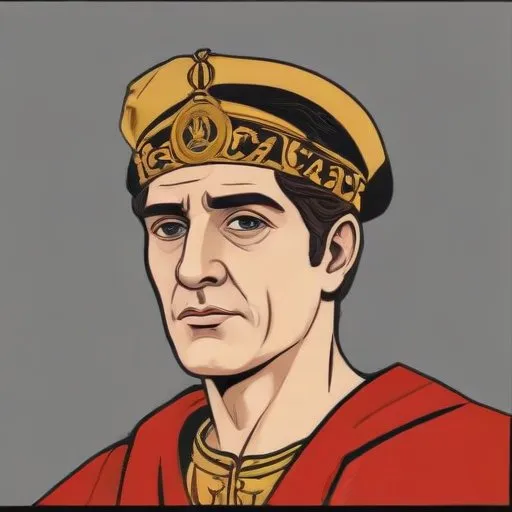
Constantine I of Greece: The King Who Shaped Modern Greece
War Hero and National Leader
Constantine I of Greece is remembered as the king who led Greece to significant military victories, expanded the country's borders, and played a crucial role in shaping modern Greece. He is best known for his command of the Hellenic Army during the successful Balkan Wars of 1912-1913, which doubled Greece's area and population.
Early Life and Accession
Constantine was born on August 2, 1868, in Athens, Greece, to King George I and Queen Olga. As the eldest son, he was the first Greek-born member of the royal family, and his birth was met with great enthusiasm. He was named after his maternal grandfather, Grand Duke Konstantin of Russia.
Military Career and Key Conflicts
Constantine's military career spanned over two decades, during which he played a significant role in several key conflicts. He was the commander-in-chief of the Hellenic Army during the Greco-Turkish War of 1897, although the war ended in defeat for Greece. However, he redeemed himself during the Balkan Wars of 1912-1913, leading the Greek forces to significant victories.
World War I and the National Schism
Constantine's disagreement with Prime Minister
Eleftherios Venizelos over whether Greece should enter World War I led to the National Schism, a period of great upheaval in Greece. The country was essentially split between the pro-Venizelos North and the royalist South, leading to a protracted civil war.
Exile and Abdication
Under Allied duress, Constantine was forced to leave Greece in 1917, and his second son, Alexander, became king. However, after Alexander's death and Venizelos' defeat in the 1920 legislative elections, Constantine was reinstated as king. He abdicated the throne for the second and last time in 1922, following Greece's defeat in the Greco-Turkish War of 1919-1922.
Personal Life and Legacy
Constantine married Princess
Sophia of Prussia in 1889, and they had six sons and one daughter together. He died on January 11, 1923, in exile in Sicily, Italy, from heart failure and brain hemorrhage. Despite his tumultuous reign, Constantine is remembered as a key figure in modern Greek history, who played a significant role in shaping the country's borders and destiny.
Key Dates and Milestones
- August 2, 1868: Born in Athens, Greece
- 1897: Led the Hellenic Army during the Greco-Turkish War
- 1912-1913: Led the Greek forces during the Balkan Wars
- 1913: Ascended to the throne following his father's assassination
- 1917: Forced to leave Greece under Allied duress
- 1920: Reinstated as king following his son's death and Venizelos' defeat
- 1922: Abdicated the throne for the second and last time
- January 11, 1923: Died in exile in Sicily, Italy
FAQ
Who was Constantine I of Greece?
Constantine I was the King of Greece from 1913 to 1917 and again from 1920 to 1922. He played a key role in Greeces involvement in World War I and was the first king to be born in Greece.
What were Constantine Is contributions to Greece?
Constantine I made significant contributions to Greece, including modernizing the Greek army and promoting economic development. He also supported the Megali Idea, a movement to unite all Greeks within a single state.
What was Constantine Is relationship like with his son, Alexander?
Constantine Is relationship with his son, Alexander, was complex and often tumultuous. Alexander would later become King of Greece, but their differing views on politics and governance led to conflicts.
Why was Constantine I forced into exile?
Constantine I was forced into exile in 1917 due to his pro-German stance during World War I, which was unpopular with the Greek people and the Allies. He was eventually restored to the throne in 1920, but was again forced into exile in 1922.
What was Constantine Is legacy?
Constantine Is legacy is complex and contested. While he made significant contributions to Greece, his authoritarian style and pro-German stance during World War I have been criticized by historians.