


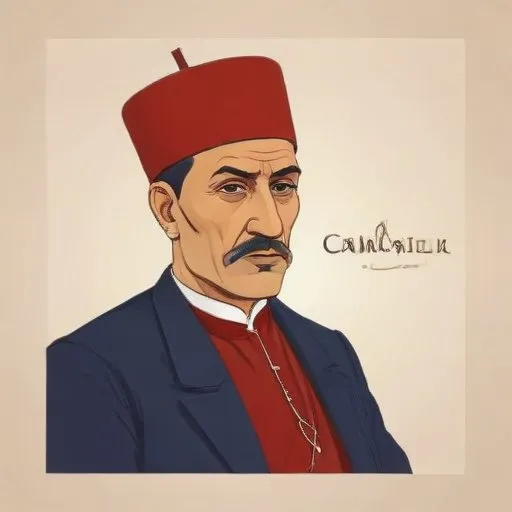
Ottoman-French polymath and naturalist who made significant contributions to various fields, including botany, zoology, and linguistics, and is credited with discovering over 6,700 plant species.
Constantine Samuel Rafinesque was a French-American polymath, born on October 22, 1783, in Galata, a suburb of Constantinople, who left an indelible mark on various fields, including botany, zoology, linguistics, and anthropology. He is best known for his groundbreaking contributions to the study of prehistoric earthworks in North America and his theories on the origins of Native Americans.
Rafinesque's intellect and curiosity were evident from a young age. He was mostly self-educated, never attending university, yet taught himself Greek and Latin by the age of 14. This autodidacticism allowed him to excel in various fields, making him a true polymath.
Rafinesque spent his youth in Marseilles, collecting plants for an herbarium from the age of 12. In 1802, he sailed to Philadelphia with his younger brother, marking the beginning of his American odyssey. His travels took him across the United States, ultimately settling in Ohio in 1815.
Rafinesque's work was prolific and diverse, with significant contributions to:
Despite his remarkable achievements, Rafinesque's work was often met with skepticism and rejection by the scientific community during his lifetime. His submissions were frequently dismissed by leading journals, and he was never recognized for his contributions.
Rafinesque's eccentricity and erratic nature often overshadowed his genius. He died on September 18, 1840, leaving behind a vast body of work that would later be rediscovered and celebrated. Today, he is recognized as a pioneering figure in American science, and his work continues to inspire new generations of scholars.
"I would rather be a pioneer in a new country, than a follower in an old one."
Rafinesque's work has had a lasting impact on our understanding of the natural world and human history. His discoveries and theories paved the way for future scientists, anthropologists, and linguists, shaping our understanding of the Americas and beyond.
Constantine Samuel Rafinesque's remarkable story serves as a testament to the power of human curiosity, perseverance, and innovation, reminding us that even the most marginal figures can have a profound impact on our collective knowledge and understanding.
Born in 1769
A pioneering geographer and explorer who mapped much of South America and discovered the Caspian Sea's connection to the Black Sea, greatly advancing our understanding of the natural world.
Born in 1744
A French soldier, biologist, and academic who developed a theory of inheritance of acquired characteristics, proposing that organisms adapt to their environment and pass on those traits to their offspring.
Born in 1769
Founded the field of comparative anatomy, establishing extinction as a fact and creating a framework for understanding the natural world through fossil records.
Born in 1785
A pioneering ornithologist and artist, famous for meticulously illustrating and documenting North American bird species in his iconic book "The Birds of America". His work remains a cornerstone of ornithology and wildlife art.
Born in 1797
A Scottish geologist who pioneered the concept of uniformitarianism, which states that the Earth's geological features were shaped by slow, gradual processes over millions of years. His work laid the foundation for modern geology and influenced Charles Darwin's theory of evolution.
Born in 1817
A 19th-century thinker who advocated for simple living, civil disobedience, and individualism, inspiring generations to reevaluate their relationship with nature and society.
Born in 1803
A leading figure in the Transcendentalist movement, he advocated for individualism, self-reliance, and nature-inspired spirituality through his essays and poetry. His ideas continue to influence American thought and culture.
Born in 1810
A pioneering botanist who contributed significantly to the development of American botany, particularly in the fields of plant classification and evolution.
