


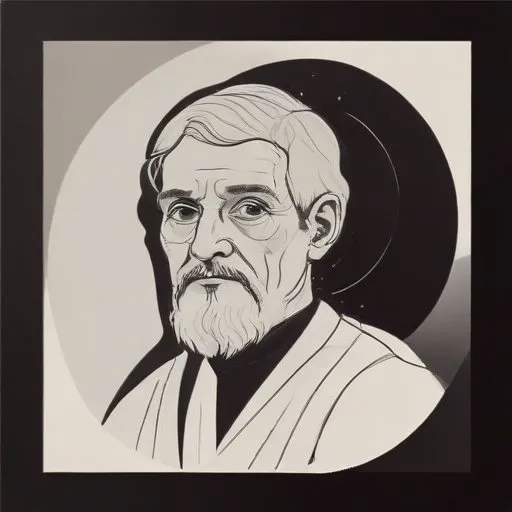
A 16th-century Dutch astronomer and astrologer who calculated the positions of celestial bodies and wrote about comets, predicting their returns. His work influenced later astronomers like Tycho Brahe.
Cornelius Gemma, a Flemish physician, astronomer, and astrologer, left an indelible mark on the scientific community of the 16th century. He is renowned for his groundbreaking observations of the 1572 supernova, lunar eclipses, and comets, as well as his pioneering work in the fields of medicine, astronomy, and astrology.
Born on February 28, 1535, in Leuven, Gemma was the oldest son of the esteemed cartographer and instrument maker, Gemma Frisius. He attended the Latin school in Mechelen and later pursued his studies at the University of Leuven, where he excelled in the arts and medical faculties.
Gemma's astronomical endeavors earned him recognition among his contemporaries. He accurately recorded a lunar eclipse in 1569 and, two days before Tycho Brahe, observed the 1572 supernova in Cassiopeia, which he referred to as a "New Venus." His work, De arte cyclognomica, published in 1569, features the first scientific illustration of the aurora.
In the realm of medicine, Gemma made significant strides. His 1552 publication features the first illustration of a human tapeworm, demonstrating his fascination with the intricacies of human anatomy. His comprehensive approach to medicine is reflected in his major works, De arte cyclognomica and De naturae divinis characterismis, which integrate concepts from medicine, astronomy, astrology, teratology, divination, eschatology, and encyclopaedism.
Gemma's fascination with the natural world extended beyond the realm of science and medicine. He is recognized as the first true orchid hobbyist, displaying a passion for these exquisite flowers that would later become a hallmark of his legacy.
Gemma's contributions to various fields have left a lasting impression on modern intellectual history. His work, though often overlooked, provides a fascinating glimpse into the Renaissance mind, where disciplines blurred and interdisciplinary approaches flourished. Despite his untimely death in 1578, at the age of 43, Gemma's legacy continues to inspire future generations of scholars and scientists.
Gemma's remarkable life and work serve as a testament to the power of human curiosity and the boundless potential of the human mind.
Born in 1546
A 16th-century astronomer who made precise measurements of the stars and planets, laying the foundation for modern astronomy. His data helped Kepler discover planetary orbits.
Born in 1571
A 17th-century trailblazer who discovered the three laws of planetary motion, revolutionizing our understanding of the solar system. He's also credited with being a pioneer in the field of astrology.
Born in 1564
Pioneering astronomer, physicist, and mathematician who played a major role in the Scientific Revolution, making key discoveries that challenged Aristotelian views and laid the foundation for modern science.
Born in 1473
A Renaissance-era mathematician and astronomer who proposed the heliocentric model, where the Sun is at the center of our solar system, revolutionizing our understanding of the universe.
Born in 1550
A 16th-century astronomer and mathematician who calculated the orbit of celestial bodies and was a key figure in the development of Kepler's laws of planetary motion. Known for his precise astronomical tables and observations that helped shape modern astronomy.
Born in 1592
Designed one of the first mechanical calculators and made significant contributions to astronomy, particularly in the field of lunar eclipses.
Born in 1495
A 16th-century mathematician and astronomer who calculated the distances of celestial bodies and created detailed astronomical charts, making significant contributions to the field of astronomy.
