


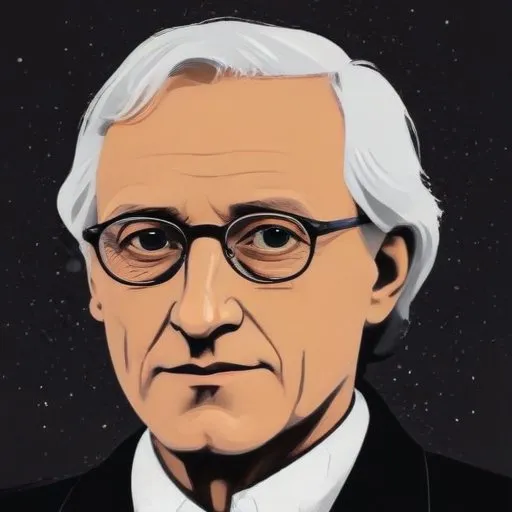
A 16th-century astronomer and mathematician who calculated the orbit of celestial bodies and was a key figure in the development of Kepler's laws of planetary motion. Known for his precise astronomical tables and observations that helped shape modern astronomy.
Michael Maestlin, a 16th-century German astronomer and mathematician, is best known for being the mentor of the renowned Johannes Kepler. He is widely regarded as one of the most significant astronomers between the time of Copernicus and Kepler, and his contributions to the field of astronomy have had a lasting impact on modern science.
Maestlin was born on September 30, 1550, in Göppingen, a small town in Southern Germany. He was the son of Jakob Maestlin and Dorothea Simon, and was born into a Protestant family. Maestlin's family name was originally Leckher or Legecker, and they lived in the village of Boll, just a few kilometers south of Göppingen.
In 1565, Maestlin began his studies at the University of Tübingen, where he became a student of Philipp Apian, a renowned mathematician and astronomer. It was during this time that Maestlin developed a strong foundation in mathematics and astronomy, which would later serve him well in his career.
Maestlin's most notable contribution to astronomy was his work on the Rudolphine Tables, a set of astronomical tables that were instrumental in the development of modern astronomy. He also made significant contributions to the field of trigonometry, and his work on the subject was widely regarded as some of the most accurate and comprehensive of his time.
In addition to his work on the Rudolphine Tables, Maestlin also made important contributions to the field of astronomy through his observations of celestial bodies. He was one of the first astronomers to observe the comet of 1577, and his observations of the comet of 1580 were instrumental in the development of modern comet theory.
Maestlin's work had a significant impact on modern society, particularly in the fields of astronomy and mathematics. His contributions to the Rudolphine Tables helped to lay the foundation for modern astronomy, and his work on trigonometry helped to pave the way for major breakthroughs in fields such as physics and engineering.
In addition to his scientific contributions, Maestlin also played an important role in the development of modern education. He was a strong advocate for education, and his teachings had a profound impact on many young minds, including that of Johannes Kepler.
In 1577, Maestlin married Margarete Grüniger, and the couple had several children together. After Margarete's death in 1588, Maestlin remarried, taking Margarete Burkhardt as his wife. He had eight children with Burkhardt, and his family life was marked by both joy and tragedy, including the death of his infant son, August, in 1589.
Maestlin's personal life was marked by a deep sense of faith and a strong commitment to his family. Despite the challenges he faced, he remained dedicated to his work and continued to make significant contributions to the field of astronomy throughout his life.
Michael Maestlin's legacy is that of a dedicated and passionate astronomer who made significant contributions to our understanding of the universe. Through his work on the Rudolphine Tables and his observations of celestial bodies, he helped to lay the foundation for modern astronomy. His influence on Johannes Kepler and other prominent astronomers of his time is a testament to the impact he had on the development of modern science.
In conclusion, Michael Maestlin was a true pioneer in the field of astronomy, and his contributions to the field have had a lasting impact on modern society. His legacy serves as a reminder of the importance of dedication, hard work, and a passion for discovery.
This quote, attributed to Maestlin, serves as a reminder of the importance of humility and curiosity in the pursuit of scientific knowledge.
Through his work and legacy, Michael Maestlin continues to inspire generations of scientists and scholars, and his contributions to the field of astronomy remain a testament to the power of human ingenuity and curiosity.
Born in 1571
A 17th-century trailblazer who discovered the three laws of planetary motion, revolutionizing our understanding of the solar system. He's also credited with being a pioneer in the field of astrology.
Born in 1546
A 16th-century astronomer who made precise measurements of the stars and planets, laying the foundation for modern astronomy. His data helped Kepler discover planetary orbits.
Born in 1473
A Renaissance-era mathematician and astronomer who proposed the heliocentric model, where the Sun is at the center of our solar system, revolutionizing our understanding of the universe.
Born in 1564
Pioneering astronomer, physicist, and mathematician who played a major role in the Scientific Revolution, making key discoveries that challenged Aristotelian views and laid the foundation for modern science.
Born in 1592
A 17th-century polymath who made significant contributions to the scientific revolution, merging ancient Greek philosophy with modern scientific methods, and providing a foundation for modern astronomy. He's also known for his work on the concept of the vacuum and the behavior of gases.
Born in 1544
A 16th-century English physician, physicist, and astronomer who pioneered the study of magnetism and electricity, and is credited with coining the term "electricity".
