


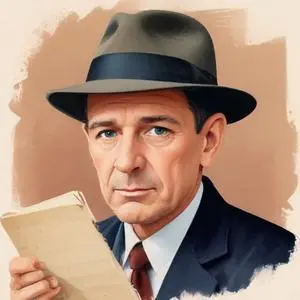
Renowned war correspondent and author of meticulously researched, bestselling books on World War II, including "The Longest Day" and "A Bridge Too Far".
Cornelius Ryan was an Irish-American journalist and author renowned for his exhaustive and gripping accounts of World War II. His meticulously researched and vividly written books, including The Longest Day, The Last Battle, and A Bridge Too Far, have become seminal works on the subject, captivating readers and historians alike.
Ryan was born on June 5, 1920, in Dublin, Ireland, where he was educated at Synge Street CBS, Portobello. His early life was marked by a strong connection to his Catholic faith, serving as an altar boy at St. Kevin's Church, Harrington Street. Ryan's artistic inclinations were nurtured through his study of the violin at the Irish Academy of Music in Dublin.
Ryan's foray into journalism began in 1940, when he moved to London to work as a war correspondent for The Daily Telegraph. He covered the air war in Europe, flying on fourteen bombing missions with the Eighth and Ninth United States Army Air Forces (USAAF). Ryan's proximity to the battlefield and his keen observational skills earned him a reputation as a fearless and intrepid journalist.
His experiences during World War II formed the basis of his most acclaimed works. The Longest Day (1959), an epic account of D-Day, June 6, 1944, showcases Ryan's meticulous attention to detail and his ability to weave individual stories into a larger narrative. The Last Battle (1966) and A Bridge Too Far (1974) further solidified his status as a master chronicler of World War II.
Ryan's work has had a profound impact on modern society, influencing the way we remember and understand World War II. His books have been adapted into films and television series, introducing his work to a broader audience. The Longest Day, in particular, has become a cultural touchstone, with its title becoming synonymous with D-Day.
In 1947, Ryan immigrated to the United States, where he became a naturalized citizen in 1951. He worked for Time magazine, reporting on the post-war tests of atomic weapons in the Pacific and covering the Israeli war in 1948. Ryan's personal life was marked by his marriage and his later years, during which he continued to write and contribute to various publications.
Ryan's writing reflects his commitment to telling the stories of ordinary people caught in the midst of extraordinary events. His work seeks to humanize history, highlighting the courage, sacrifice, and resilience of those who lived through World War II. Through his writing, Ryan conveys the importance of understanding the past, lest we forget the lessons of history.
Ryan's writing is characterized by his vivid descriptions and poignant observations. One of his most memorable quotes, from The Longest Day, reads: "The war had reached its climax, and the fate of the world hung in the balance. It was a time of great heroism, of sacrifice, of triumph, and of tragedy."
Cornelius Ryan's legacy extends far beyond his written works. He played a significant role in shaping the public's understanding of World War II, providing a nuanced and multifaceted perspective on the conflict. Ryan's work serves as a testament to the power of journalism, highlighting the importance of humanizing history and preserving the stories of those who lived through it.
Ryan's passing on November 23, 1974, marked the end of an era, but his work continues to inspire new generations of historians, writers, and readers alike. His meticulous research, vivid storytelling, and commitment to preserving the stories of World War II have cemented his place as one of the most important chroniclers of the 20th century.
Born in 1900
A Pulitzer Prize-winning war correspondent who reported from the front lines, providing intimate and humanizing stories of soldiers during World War II.
Born in 1916
Legendary news anchor and voice of authority, known for delivering trusted and unbiased reporting during pivotal moments in American history, including the Apollo 11 moon landing.
Born in 1908
Pioneering broadcast journalist who exposed Senator Joseph McCarthy's communist witch hunt, setting a high standard for fearless reporting.
Born in 1914
Pulitzer Prize-winning journalist and author who exposed the horrors of war through his writing, most notably with his book "Hiroshima", which told the story of the atomic bombing of Hiroshima from the perspective of six survivors.
Born in 1889
Co-founder of The New Republic, a pioneering journalist and publisher who shaped American political discourse with his influential writings and opinions. He's most known for his insightful commentary on democracy, politics, and society.
Born in 1913
A pioneering journalist and TV personality who wrote a syndicated column and appeared on the popular game show "What's My Line?", known for her wit, charm, and investigative reporting skills.
91 Years Old
A Pulitzer Prize-winning journalist and academic who reported on several major conflicts, including the Vietnam War, and was one of the few Western journalists to remain in Baghdad during the Gulf War. Known for his courageous and insightful reporting from war zones.
94 Years Old
A renowned journalist and author, known for his in-depth reporting and storytelling on 60 Minutes, covering a wide range of topics, from politics to culture.
