


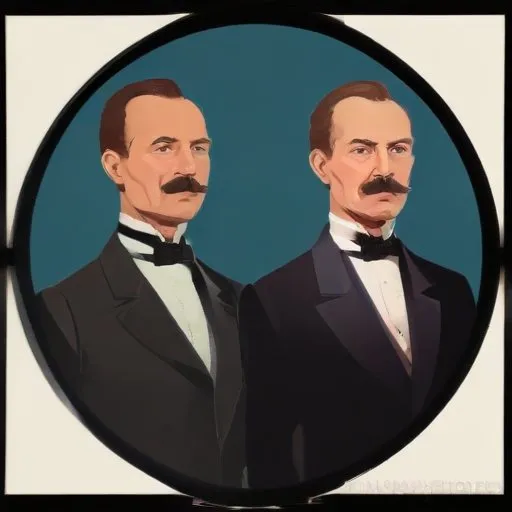
The Joint Foreign Minister of Austria-Hungary who played a crucial role in the events leading up to World War I, issuing the ultimatum to Serbia that sparked the war. He was a key figure in the complex system of alliances that led to the outbreak of global conflict.
Count Leopold Berchtold, born on April 18, 1863, was an Austrian-Hungarian politician and diplomat, best known for serving as the Foreign Minister of Austria-Hungary during the tumultuous period preceding World War I. His tenure, marked by a series of miscalculations and diplomatic blunders, ultimately contributed to the downfall of the Austro-Hungarian Empire.
Born into the noble Illesházy family, Berchtold's upbringing was steeped in tradition and diplomacy. He entered the Austro-Hungarian foreign service in 1893, where he rapidly rose through the ranks, earning a reputation as a skilled and sophisticated diplomat. In 1912, he was appointed as the Austro-Hungarian Ambassador to Russia, a position that would prove pivotal in the lead-up to World War I.
In June 1914, the assassination of Archduke Franz Ferdinand of Austria by Gavrilo Princip, a Bosnian Serb nationalist, sent shockwaves throughout Europe. Berchtold, now Foreign Minister, played a crucial role in the subsequent events, as he sought to use the crisis to crush the growing Serb nationalist movement. His decision to issue an ultimatum to Serbia, which included demands that the Serbian government could not accept, ultimately led to the declaration of war.
Berchtold's personal life was marked by a long-standing affair with Hildegarde Tauszik, a Hungarian aristocrat. Their relationship, which began in the early 1900s, remained a closely guarded secret, known only to a select few within the aristocratic circles. This clandestine romance had no discernible impact on his political career, but it speaks to the complexities of his personal life.
Berchtold's role in the lead-up to World War I has been the subject of much debate and criticism. While some historians view him as a hapless figure, caught in the vortex of events beyond his control, others see him as a symbol of the arrogance and shortsightedness of the Austro-Hungarian elite. Regardless, his actions had far-reaching consequences, reshaping the European landscape and paving the way for the rise of new world powers.
Berchtold's worldview was shaped by a belief in the primacy of the Austro-Hungarian Empire and the importance of maintaining the status quo. He saw himself as a guardian of tradition, working to preserve the power and influence of the Habsburg dynasty. This ideology, however, blinded him to the growing tensions and nationalist movements that ultimately led to the empire's downfall.
| 1863 | Born on April 18th in Vienna, Austria |
| 1893 | Entered the Austro-Hungarian foreign service |
| 1912 | Appointed as the Austro-Hungarian Ambassador to Russia |
| 1914 | Became Foreign Minister of Austria-Hungary |
| 1914 | Issued the ultimatum to Serbia, leading to the declaration of war |
| 1923 | Died on November 21st in Peresznye, Hungary |
Count Leopold Berchtold's life serves as a cautionary tale of the dangers of diplomatic miscalculations and the devastating consequences of unchecked nationalism. As we reflect on his legacy, we are reminded of the importance of diplomacy, cooperation, and understanding in preventing the catastrophes that have plagued human history.
Born in 1830
The longest-reigning ruler of Austria-Hungary, presiding over a vast empire that spanned across Central Europe, and remembered for his role in shaping European history through diplomacy and war.
Born in 1894
A Bosnian Serb revolutionary who assassinated Archduke Franz Ferdinand of Austria, sparking World War I. This event changed the course of history, leading to widespread devastation and global repercussions.
