


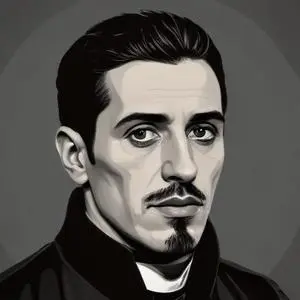
A Bosnian Serb revolutionary who assassinated Archduke Franz Ferdinand of Austria, sparking World War I. This event changed the course of history, leading to widespread devastation and global repercussions.
Gavrilo Princip, a Bosnian Serb student, is notoriously known for assassinating Archduke Franz Ferdinand, heir presumptive to the throne of Austria-Hungary, and his wife Sophie, Duchess von Hohenberg, in Sarajevo on June 28, 1914. This event sparked the July Crisis, a chain reaction that led to the outbreak of World War I, one of the most devastating conflicts in human history.
Princip was born on July 25, 1894, in western Bosnia, to a poor Serb family. At the tender age of 13, he was sent to Sarajevo, the capital of Austrian-occupied Bosnia, to study at the Merchants School. He later transferred to the gymnasium, where he became politically aware and developed a strong sense of nationalism.
In 1911, Princip joined Young Bosnia, a secret local society aiming to free Bosnia from Austrian rule and achieve the unification of the South Slavs. He attended anti-Austrian demonstrations in Sarajevo, which eventually led to his expulsion from school. Undeterred, he walked to Belgrade, Serbia, to continue his education.
Inspired by a spate of assassination attempts against Imperial officials by Slavic nationalists and anarchists, Princip conspired with two other young Bosnians to assassinate Archduke Franz Ferdinand during his announced visit to Sarajevo. The Black Hand, a Serbian secret society with ties to Serbian military intelligence, provided the conspirators with weapons and training before facilitating their re-entry into Bosnia.
On Sunday, June 28, 1914, Princip assassinated the Archduke and his wife, setting off a chain reaction that would engulf Europe in war.
The assassination of Archduke Franz Ferdinand is widely regarded as the immediate cause of World War I. Princip's actions led to a series of diplomatic crises, alliances, and military mobilizations that ultimately resulted in the outbreak of war. His legacy is marked by controversy, with some viewing him as a national hero and others condemning him as a terrorist.
Princip's actions were motivated by a strong sense of nationalism and a desire for the unification of the South Slavs. He believed that the only way to achieve this goal was through violent revolution and the elimination of Austro-Hungarian rule.
The assassination of Archduke Franz Ferdinand had a profound impact on modern society, leading to the devastation of World War I and subsequent global conflicts. Princip's actions also inspired other nationalist and revolutionary movements, shaping the course of global politics in the 20th century.
Princip's actions and ideology can be compared to those of other contemporary nationalist and revolutionary figures, such as Vladimir Lenin and Mustafa Kemal Atatürk. While their methods and goals differed, they all played significant roles in shaping the course of modern history.
84 Years Old
The first President of Serbia, a mastermind behind the Yugoslav Wars, and a key figure in the Kosovo conflict, known for his nationalist and authoritarian rule.
83 Years Old
A Serbian general who orchestrated the Siege of Sarajevo and other atrocities during the Bosnian War, earning him the nickname "The Butcher of Bosnia".
81 Years Old
The first President of Republika Srpska, a convicted war criminal, known for his role in the Bosnian War and ethnic cleansing. He's infamous for his involvement in the Srebrenica massacre.
Born in 1870
Founder of the world's first socialist state, leading the Bolshevik Revolution and establishing the Soviet Union, known for his radical Marxist ideology and authoritarian rule.
Born in 1878
The Soviet Union's ruthless leader who ruled with an iron fist, implementing policies that led to widespread famine and purges, while also playing a crucial role in defeating Nazi Germany in World War II.
95 Years Old
The last leader of the Soviet Union, who introduced reforms that led to the end of the Cold War and the collapse of communism, earning a Nobel Peace Prize. He's known for his policies of glasnost and perestroika, which transformed the Soviet Union and the world.
Born in 1892
Led the Yugoslav Partisans to victory in World War II and later became a unifying figure, serving as the President of Yugoslavia from 1953 to 1980. He's known for his unique blend of communist and nationalist policies.
