


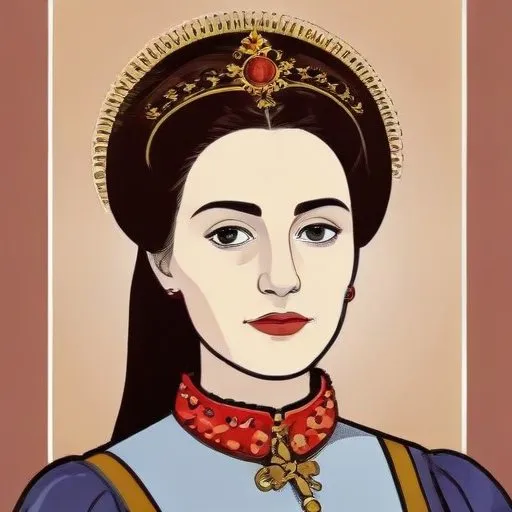
A 15th-century German noblewoman who married into the House of Hanau and played a significant role in the region's politics and cultural development. She's also known for her patronage of the arts and education.
Countess Palatine Margaret of Mosbach, born on March 2, 1432, is famously remembered for her pivotal role in the division of the County of Hanau. This sharp-witted countess played a crucial part in shaping the fate of her family's dynasty, making her a significant figure in the annals of history.
The eldest daughter of Count Palatine Otto I of Mosbach and his wife, Johanna of Bavaria-Landshut, Margaret was destined for greatness. She married Count Reinhard III of Hanau on July 11, 1446, a union that would ultimately thrust her into the midst of a dynastic dilemma.
When Count Reinhard III succeeded his father as the ruling Count in 1451, his young son, Philip the Younger, was only four years old. This presented the Hanau family with a conundrum: whether to follow the primogeniture rule, which would allow Philip the Younger to inherit the entire county, or to divide the territory to ensure the continuation of the dynasty.
Margaret, however, advocated for the primogeniture solution, which would grant her son the entire county. Her father, Otto I, supported her stance. This decision would have far-reaching consequences, shaping the course of the Hanau dynasty and the future of the county.
Countess Palatine Margaret of Mosbach's bold decision-making and strategic thinking have left an indelible mark on history. Her actions demonstrated the strength and agency of women in a patriarchal society, making her a trailblazer in her own right.
Countess Palatine Margaret of Mosbach's remarkable story serves as a testament to the power of strategic thinking and determination in the face of adversity. Her legacy continues to inspire, reminding us of the profound impact one person can have on the course of history.
Born in 1478
Elector of the Palatinate, a powerful German state, and leader of the Protestant Union during the Thirty Years' War. He's known for his role in the early stages of this devastating conflict.
Born in 1482
Ruler of the Palatinate region in Germany during the 16th century, known for his role in the Protestant Reformation and his brief reign as King of Bohemia. He sparked the Thirty Years' War, a devastating conflict that ravaged Europe.
Born in 1661
The Elector Palatine was a German nobleman who ruled the Palatinate region and played a significant role in the War of the Spanish Succession. He's known for his diplomatic efforts and territorial expansions.
Born in 1756
King of Bavaria from 1806 to 1825, known for his liberal reforms and modernization of the country, earning him the title "Father of the Constitution".
Born in 1786
The King of Bavaria who commissioned the iconic Neuschwanstein Castle, a fairytale-like palace that inspired the Disney castle, and was a patron of the arts, supporting Richard Wagner's operas.
