


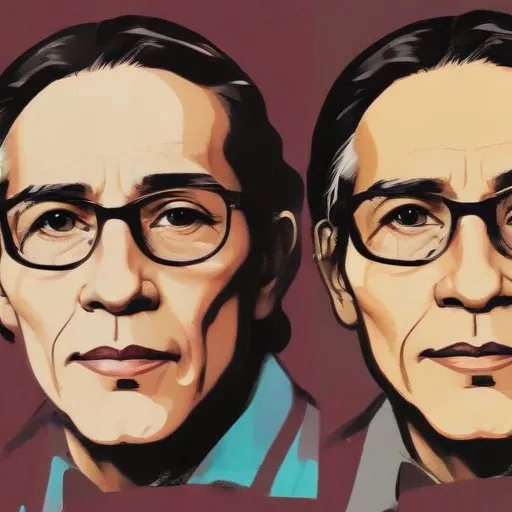
A pioneering poet who revolutionized Spanish-language literature with innovative, avant-garde styles and socially conscious themes. His works explored the human condition, politics, and social justice.
Vallejo was born on March 16, 1892, in Santiago de Chuco, a remote village in the Peruvian Andes, to Francisco de Paula Vallejo Bentez and Mara de los Santos Mendoza Gurrionero. He was the youngest of eleven children, with Spanish priest grandfathers and indigenous Peruvian grandmothers. Due to financial struggles, Vallejo had to withdraw from his studies temporarily to work at a sugar plantation, where he witnessed the exploitation of agrarian workers firsthand, an experience that would later shape his politics and aesthetics.
Vallejo received a BA in Spanish literature in 1915 and became acquainted with the bohemia of Trujillo, including APRA cofounders Antenor Orrego and Victor Raul Haya de la Torre. In 1911, he moved to Lima, where he studied at National University of San Marcos, worked as a schoolteacher, and came into contact with the artistic and political avant-garde.
Vallejo's first poetry collection, Los heraldos negros, was published in 1919, a year after its stated publication date. This work showcased his unique style, which blended modernism with indigenous Peruvian influences. His second and final book of poetry, Trilce, was published in 1922, further solidifying his reputation as a poetic innovator.
After his move to Europe in 1923, Vallejo continued to write, producing plays, poems, and essays. His work was heavily influenced by his experiences as an immigrant and his observations of European society. Some of his notable works from this period include Paco Yunque, a play that critiques Peruvian society, and Russia in 1931, a collection of essays on his experiences traveling through the Soviet Union.
Vallejo's impact on modern poetry is immeasurable. His unique style, which blended modernism with indigenous Peruvian influences, paved the way for future generations of poets. The late British poet, critic, and biographer Martin Seymour-Smith called Vallejo the greatest twentieth-century poet in any language.
In 1979, Clayton Eshleman and Jos Rubia Barcia's translation of The Complete Posthumous Poetry of Csar Vallejo won the National Book Award for translation, further cementing Vallejo's legacy.
Vallejo was a member of the intellectual community known as the North Group, formed in the Peruvian north coastal city of Trujillo. He was deeply concerned with social justice and was influenced by Marxist ideologies, which are reflected in his writing.
Vallejo's philosophical beliefs were shaped by his experiences as an immigrant and his observations of European society. He believed in the power of poetry to spark social change and was critical of the exploitation of indigenous peoples and the working class.
Csar Vallejo passed away on April 15, 1938, leaving behind a legacy that continues to inspire poets and writers around the world. His innovative style, his commitment to social justice, and his contributions to modern poetry have solidified his place as one of the greatest poets of the 20th century.
90 Years Old
A Nobel Prize-winning writer and politician who explored the complexities of Peruvian society through his novels and essays, and later ran for president. His works often blended politics, history, and fiction.
Born in 1904
A Chilean poet and diplomat who wrote passionate and evocative poetry that explored love, politics, and the human condition, and was awarded the Nobel Prize in Literature in 1971.
Born in 1914
A Mexican poet and diplomat who won the Nobel Prize in Literature in 1990 for his work that explores the intersection of poetry, philosophy, and politics. He's known for his lyrical and introspective style that explores the human condition.
99 Years Old
A Colombian journalist and author who crafted magical realism, a literary style that blends fantasy and reality, and won the Nobel Prize in Literature in 1982. His works are known for their vivid storytelling and exploration of human experience.
Born in 1899
A visionary writer who crafted intricate, philosophical tales that blurred reality and fantasy, influencing generations of authors and thinkers. 82
Born in 1914
A pioneering figure in magical realism, blending fantastical elements with everyday life in his novels and short stories, exploring the human condition and social commentary.
Born in 1904
A Swiss-Cuban musicologist and author who explored the intersection of music, culture, and politics in his work, blending magical realism with historical narratives. He's most known for his influential novels that shaped the Latin American literary boom.
Born in 1917
A pioneering writer and photographer who blended magical realism with stark social commentary, capturing the essence of rural Mexico through his poignant and evocative works.
