


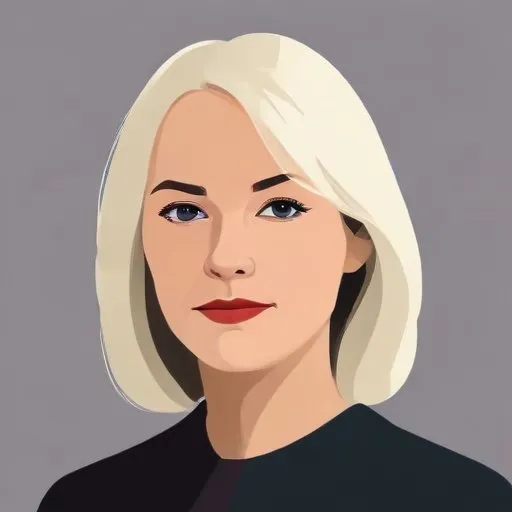
A pioneering female journalist who broke into the male-dominated news industry in Norway, known for her courageous reporting and advocacy for women's rights.
Dagmar Loe, a Norwegian journalist, is renowned for fearlessly tackling contentious issues such as abortion, incest, rape, dementia, imprisonment of juveniles, and arms trading, shaping the landscape of Norwegian media and beyond. During her three-decade tenure at NRK, she relentlessly pursued telling the untold stories, giving voice to the voiceless, and shedding light on the darkest corners of society.
Born on January 19, 1923, as Dagmar Scheflo, she was the daughter of journalist and politician Olav Scheflo, a stalwart in the Labour Party. Growing up in an environment of ideological debates and activism, Dagmar's childhood was deeply influenced by her father's passion for social justice. The outbreak of World War II, the German occupation, and the subsequent resistance movement further shaped her perspectives, instilling in her a strong sense of conviction and moral compass.
In 1945, Loe embarked on her journalistic journey as an office assistant at the news agency Arbeidernes Pressebyr, eventually transitioning to freelance work and writing for various publications. Her early writings reflected her commitment to social justice, tackling topics that were hitherto considered off-limits. The 1960s saw her authoring books, including Landslaget for husstell, which cemented her position as a pioneering journalist.
Loe's unwavering dedication to her craft was recognized with the prestigious Narvesen Prize in 1988 and the Fritt Ord Honorary Award in 1993. These honors acknowledged her pioneering spirit, courageous storytelling, and the profound impact she had on Norwegian journalism.
In the chaos of World War II, Loe and her family fled Norway, crossing the Swedish border in 1940. She also experienced a brief stint at the Grini concentration camp in 1945, an event that would later inform her reportage on human rights and social justice. These formative experiences instilled in her a deep empathy for the marginalized and a determination to expose the truth.
Dagmar Loe's fearless pursuit of truth, her refusal to shy away from controversy, and her dogged determination to amplify marginalized voices have left an indelible mark on Norwegian journalism. Her work continues to inspire generations of journalists, activists, and social change-makers, cementing her place as a trailblazing icon in the world of media and beyond.
"The most powerful stories are those that challenge our assumptions, disturb our comfort zones, and push us to confront the darkness within ourselves and our societies." - Dagmar Loe
As we reflect on Dagmar Loe's remarkable life and legacy, we are reminded of the transformative power of courageous storytelling, the importance of speaking truth to power, and the enduring impact of a life dedicated to social justice and human rights.
Born in 1861
A Norwegian pioneer who explored the Arctic, made groundbreaking scientific discoveries, and championed humanitarian causes, earning a Nobel Prize for his efforts. He's most famous for being the first to cross Greenland and his innovative sled designs.
Born in 1872
First person to reach the South Pole, leading a Norwegian expedition in 1911, and a pioneer in Arctic and Antarctic exploration.
Born in 1914
A pioneering explorer who sailed ancient-style boats across oceans to prove migration theories, and led the famous Kon-Tiki expedition across the Pacific.
Born in 1911
A veteran character actor with a distinctive voice, he appeared in numerous films and TV shows, often playing authority figures or villains.
Born in 1899
A Norwegian explorer, lawyer, and politician who led the first successful expedition to Vinland, verifying the Vikings' presence in North America, and later governed Svalbard.
