


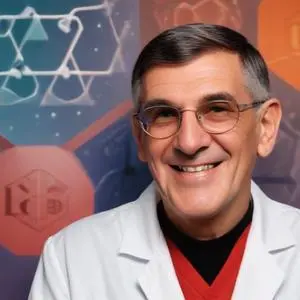
A Nobel Prize-winning chemist who discovered quasicrystals, a new form of matter with unique properties, revolutionizing materials science and earning a Nobel Prize in Chemistry.
Meet Dan Shechtman, the Israeli materials scientist who revolutionized the field of crystallography with his groundbreaking discovery of quasicrystals in 1982. This pioneering feat earned him the prestigious Nobel Prize in Chemistry in 2011, cementing his place as one of the most influential scientists of our time.
Born on January 24, 1941, in Tel Aviv, Mandatory Palestine (now Israel), Shechtman grew up in a Jewish family with a strong emphasis on education. His grandparents, who immigrated to Palestine during the Second Aliyah (1904-1914), founded a printing house, which later sparked Shechtman's fascination with the works of Jules Verne, particularly "The Mysterious Island" (1874). The protagonist's ingenuity and resourcefulness deeply resonated with the young Shechtman, who aspired to become an engineer like Cyrus Smith.
While on sabbatical at the U.S. National Bureau of Standards in Washington, D.C. in 1982, Shechtman stumbled upon an unusual crystal structure that defied the traditional understanding of crystallography. This serendipitous discovery led to the identification of quasicrystals, a new class of materials that exhibit long-range order but lack periodicity. This finding opened up new avenues for research in materials science, solid-state chemistry, and condensed matter physics.
Shechtman received his Ph.D. in Materials Engineering from the Technion in 1972, where he also obtained his B.S. degrees. He has since held various academic positions, including the Philip Tobias Professor of Materials Science at the Technion, Israel Institute of Technology, and Professor of Materials Science at Iowa State University. His work has been recognized with numerous awards, including the 2011 Nobel Prize in Chemistry, making him one of six Israelis to have achieved this distinction.
Shechtman is married to Prof. Tzipora Shechtman, a prominent psychologist, and author of two books on psychotherapy. Together, they have four children: Yoav, a postdoctoral researcher, and three daughters – Tamar, Ella, and Ruth – all of whom have pursued careers in psychology and related fields.
As a pioneer in the field of quasicrystals, Shechtman's work has far-reaching implications for fields like energy, aerospace, and nanotechnology. His discovery has inspired new generations of scientists and engineers, solidifying his place as a trailblazer in the scientific community.
"I thought that being an engineer was the best thing a person could do. The engineer in the book knows mechanics and physics, and he creates a whole way of life on the island out of nothing. I wanted to be like that." – Dan Shechtman, reflecting on his childhood inspiration
"I never expected to discover quasicrystals. It was a surprise, but a very pleasant one." – Dan Shechtman, on his Nobel Prize-winning discovery
Through his remarkable journey, Dan Shechtman has left an indelible mark on the scientific community, paving the way for future breakthroughs and innovations. His legacy serves as a testament to the power of curiosity, perseverance, and innovation.
Born in 1901
Pioneering chemist and peace activist who won two unshared Nobel Prizes, one for chemistry and one for peace, for his groundbreaking work on the nature of the chemical bond and his tireless efforts to promote nuclear disarmament.
Born in 1916
Pioneering scientist who discovered the structure of DNA, revolutionizing our understanding of genetics and life itself.
98 Years Old
Discovered the structure of DNA, revolutionizing our understanding of genetics and earning a Nobel Prize. Pioneering work in molecular biology has far-reaching implications for medicine and beyond.
Born in 1920
A British scientist who contributed significantly to the discovery of the structure of DNA, providing high-quality X-ray crystallography images that helped James Watson and Francis Crick develop their famous model.
Born in 1916
A Nobel Prize-winning physicist and biologist who contributed significantly to the discovery of the structure of DNA, using X-ray crystallography to produce the first clear images of the molecule.
Born in 1922
Pioneering biochemist and academic who deciphered the genetic code, enabling the understanding of how DNA sequences determine amino acid sequences in proteins.
Born in 1918
Pioneering biochemist who discovered the mechanism of DNA replication and was awarded the Nobel Prize in Physiology or Medicine in 1959 for his groundbreaking work on nucleic acid synthesis.
