


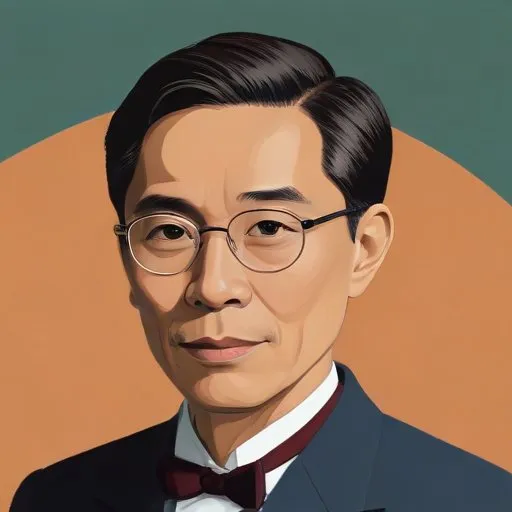
A Chinese-American physicist and academic who discovered the fractional quantum Hall effect, a phenomenon where electrons behave as quasiparticles with fractional charges. This groundbreaking work led to a deeper understanding of quantum mechanics.
Daniel C. Tsui, a renowned American physicist, is best known for his groundbreaking discovery of a new form of quantum fluid with fractionally charged excitations, which earned him the Nobel Prize in Physics in 1998. Alongside Robert B. Laughlin and Horst L. Störmer, Tsui's pioneering work has had a profound impact on our understanding of solid-state physics and its applications.
Born on February 28, 1939, in Fanzhuang, Henan, Republic of China, Tsui grew up in a rural agricultural family with illiterate parents. His early childhood was marked by the turmoil of World War II, with memories of drought, flood, and war that deeply influenced his worldview. In 1951, Tsui left for Hong Kong to pursue his education at Pui Ching Middle School, where he faced difficulties due to his unfamiliarity with the Cantonese dialect.
Upon graduating in 1957, Tsui was admitted to the National Taiwan University Medical School, but he remained in Hong Kong to enroll in the Special Classes Centre, a government program designed to prepare high school graduates for entrance into the University of Hong Kong. Tsui's academic prowess earned him a full scholarship to attend Augustana College in the United States, where he arrived in 1958 and graduated Phi Beta Kappa in 1961.
Tsui's research interests lie in the electrical properties of thin films and microstructures of semiconductors, as well as solid-state physics. His work has focused on understanding the behavior of electrons in two-dimensional systems, leading to several significant breakthroughs in the field. Tsui is currently serving as the Professor of Electrical Engineering, emeritus, at Princeton University.
In 1998, Tsui was awarded the Nobel Prize in Physics, alongside Robert B. Laughlin and Horst L. Störmer, for their discovery of a new form of quantum fluid with fractionally charged excitations. This groundbreaking research has far-reaching implications for the development of high-temperature superconductors, quantum computing, and advanced materials.
Tsui's work has not only advanced our understanding of solid-state physics but has also inspired a new generation of physicists to explore the mysteries of quantum mechanics. His legacy extends beyond the realm of physics, serving as a testament to the power of perseverance, hard work, and dedication to one's craft.
"The most exciting phrase to hear in science, the one that heralds new discoveries, is not 'Eureka!' but 'That's strange...'" - Daniel C. Tsui
This quote encapsulates Tsui's humble and inquisitive nature, reflecting his passion for uncovering the secrets of the natural world.
Tsui's work has paved the way for the development of advanced materials and technologies, including high-temperature superconductors, quantum computers, and energy-efficient devices. His discovery has also inspired new areas of research, fueling innovation and progress in the fields of physics and engineering.
As a trailblazer in solid-state physics, Tsui's contributions have not only expanded our understanding of the quantum world but have also opened up new avenues for technological advancements, promising to transform the fabric of modern society.
75 Years Old
A Nobel Prize-winning physicist who discovered the fractional quantum Hall effect, a phenomenon where electrons behave as quasiparticles with unusual properties. His work has greatly advanced our understanding of quantum mechanics.
Born in 1922
A renowned physicist who made groundbreaking contributions to our understanding of subatomic particles, earning a Nobel Prize for his work on parity non-conservation.
99 Years Old
A Chinese-American physicist and academic who won the Nobel Prize for his work on the parity non-conservation of weak interactions, revolutionizing our understanding of particle physics.
Born in 1921
A Nobel Prize-winning physicist who developed the theory of spontaneous symmetry breaking, which revolutionized our understanding of the universe's fundamental forces. His work has far-reaching implications for particle physics and beyond.
93 Years Old
Developed a unified theory of electromagnetism and the weak nuclear force, predicting the existence of neutral currents. This work led to a deeper understanding of subatomic particles and their interactions.
93 Years Old
A Nobel Prize-winning physicist who pioneered the electroweak force theory, a fundamental concept in modern particle physics. His work unified two of the four fundamental forces of nature, revolutionizing our understanding of the universe.
97 Years Old
A pioneer in particle physics, discovering subatomic particles like quarks and gluons, and developing the theory of quantum chromodynamics.
Born in 1922
A Nobel Prize-winning physicist and mathematician who discovered the muon neutrino, a subatomic particle, and made significant contributions to our understanding of the universe. His work has far-reaching implications for particle physics and beyond.
