


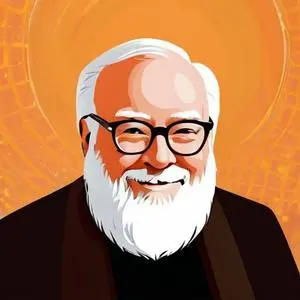
A philosopher and cognitive scientist who explores the nature of consciousness, free will, and artificial intelligence, and is known for his critiques of religious beliefs and arguments for atheism.
Daniel Dennett is a renowned American philosopher and cognitive scientist, celebrated for his groundbreaking work in the philosophy of mind, philosophy of science, and philosophy of biology, particularly in the context of evolutionary biology and cognitive science.
Dennett was born on March 28, 1942, in Boston, Massachusetts, to Ruth Marjorie (née Leck) and Daniel Clement Dennett Jr. His early life was marked by a unique blend of cultural influences, having spent part of his childhood in Lebanon, where his father worked as a covert counterintelligence agent with the Office of Strategic Services during World War II.
Dennett's academic journey took him to Phillips Exeter Academy, Wesleyan University, and eventually, Harvard University, where he earned his PhD in philosophy in 1965. This marked the beginning of a illustrious career that would span over five decades.
Dennett's philosophical contributions are vast and diverse, but he is perhaps best known for his advocacy of a philosophical position known as materialism, which posits that the mind can be reduced to physical processes in the brain. This stance has led to lively debates in the realms of philosophy of mind, free will, and the nature of consciousness.
He is also a vocal atheist and secularist, often engaging in discussions about the role of religion in modern society. This stance has earned him a place among the so-called "Four Horsemen of New Atheism," alongside Richard Dawkins, Sam Harris, and Christopher Hitchens.
Dennett's work has had a profound impact on various fields, from cognitive science and neuroscience to philosophy and artificial intelligence. His ideas have inspired a new generation of researchers, philosophers, and scientists, shaping the way we think about the human mind and its place in the natural world.
Dennett's unapologetic stance on atheism and secularism has led to controversial debates and criticism from religious leaders and scholars. However, his commitment to rational inquiry and critical thinking has earned him widespread respect and admiration within the scientific and philosophical communities.
Daniel Dennett's pioneering work has left an indelible mark on the intellectual landscape, inspiring new areas of research and inquiry. As a philosopher, scientist, and public intellectual, he continues to shape our understanding of the human mind, the natural world, and our place within it.
Through his tireless advocacy for reason, critical thinking, and scientific inquiry, Dennett has inspired countless individuals to engage with the big questions of life, encouraging us to think more deeply about who we are and how we fit into the grand tapestry of existence.
85 Years Old
A renowned evolutionary biologist and science writer, known for popularizing science and advocating for atheism through bestselling books like "The Selfish Gene" and "The God Delusion".
59 Years Old
A prominent author, philosopher, and neuroscientist who writes about the intersection of science, morality, and spirituality, and is known for his advocacy of reason and criticism of religion.
77 Years Old
A provocative and influential writer who tackled topics like politics, literature, and religion with wit and intellectual rigor, leaving a lasting impact on modern discourse.
97 Years Old
A renowned biologist and author who has made groundbreaking contributions to our understanding of ecology, evolution, and conservation, and is known for his advocacy for biodiversity and the preservation of natural habitats.
71 Years Old
A renowned expert in language, human nature, and rationality, known for bestselling books that explore the human condition, such as "The Blank Slate" and "Enlightenment Now".
60 Years Old
A prominent philosopher of mind, known for formulating the concept of "philosophical zombies" and advocating for the idea that consciousness cannot be reduced to physical processes.
94 Years Old
Developed influential theories on consciousness, language, and artificial intelligence, challenging traditional views on the mind-body problem. 82
97 Years Old
Developed groundbreaking theories on language acquisition and universal grammar, and is a prominent critic of power and propaganda in modern society.
