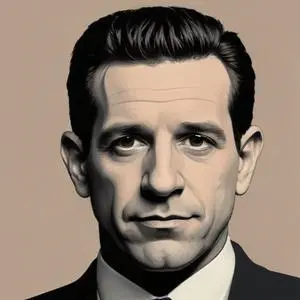
Sam Harris: The Unapologetic Critic of Faith and Defender of Reason
A Leading Voice in the New Atheism Movement
Sam Harris is renowned for his provocative critiques of religion, particularly Islam, and his advocacy for reason, science, and secularism. As one of the Four Horsemen of New Atheism, alongside
Richard Dawkins,
Christopher Hitchens, and
Daniel Dennett, Harris has been at the forefront of the modern debate on the role of faith in society.
Early Life and Education
Born on April 9, 1967, in Los Angeles, California, Harris grew up in a Jewish family and was raised with a strong emphasis on education. He earned a degree in philosophy from Stanford University and later received a Ph.D. in neuroscience from the University of California, Los Angeles (UCLA).
Philosophical Contributions and Beliefs
Harris's work has been instrumental in shaping the modern atheist movement. He argues that religious beliefs are often morally and intellectually indefensible, and that they can be harmful to individuals and society as a whole. His philosophy is centered on the idea that morality can be derived from science and reason, rather than religious dogma.
Career Highlights and Major Works
Harris's writing career took off with the publication of his first book,
The End of Faith (2004), which won the PEN/Martha Albrand Award for First Nonfiction and became a
New York Times bestseller. He has since written six additional books, including
Letter to a Christian Nation (2006),
The Moral Landscape (2010), and
Waking Up (2014). His most recent book,
Making Sense (2020), is a collection of essays that explores the intersection of science, philosophy, and politics.
Influence on Modern Society
Harris's influence extends beyond the literary world. He has been a vocal critic of religious extremism, particularly in the context of Islam, and has sparked heated debates on the role of faith in modern society. His podcast,
Making Sense, has become a platform for discussing controversial topics, from politics and science to philosophy and culture.
Controversies and Public Perception
Harris has been criticized for his perceived Islamophobia, with some accusing him of perpetuating harmful stereotypes and fueling anti-Muslim sentiment. He has also been accused of being divisive and inflammatory, particularly in his critiques of religion. However, Harris and his supporters argue that his criticism is aimed at the ideology of Islamism, rather than Muslims as individuals.
Quotes and Memorable Sayings
- "The only thing that guarantees an open-ended exploration of our potential is the willingness to say 'we don't know'."
- "The fact that our brains respond to certain stimuli in a certain way does not make the stimuli any less real."
- "The core of the problem is not religion, per se, but the way people justify their beliefs and behaviors."
Personal Milestones and Key Life Events
Harris has been open about his struggles with meditation and spirituality, having experimented with psychedelics and practiced meditation for many years. He has also been critical of the mindfulness movement, arguing that it often prioritizes individual well-being over collective progress.
Impact on Pop Culture
Harris's ideas have permeated popular culture, influencing filmmakers, writers, and musicians. His critiques of religion have inspired a new generation of thinkers and artists, from comedians like
Bill Maher to musicians like Marilyn Manson.
Awards and Honors
Harris has received numerous awards for his writing, including the PEN/Martha Albrand Award for First Nonfiction and the Sami Rohr Prize for Jewish Literature.
Legacy and Future
Sam Harris continues to be a provocative and influential voice in the world of philosophy, science, and politics. His commitment to reason, science, and humanism has inspired countless individuals to re-examine their beliefs and values. As a leading figure in the modern atheist movement, Harris's ideas will continue to shape the conversation around faith, morality, and the human condition.