


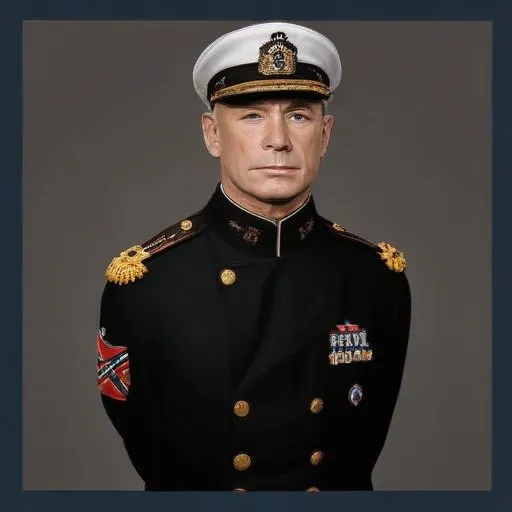
A Medal of Honor recipient and admiral who led a task force during the Naval Battle of Guadalcanal, making a crucial contribution to the Allied victory in World War II.
Daniel Judson Callaghan, a United States Navy officer, is best known for receiving the Medal of Honor posthumously for his valiant efforts during the Naval Battle of Guadalcanal. As the commander of the USS San Francisco, Callaghan led his crew in a fierce battle against a larger Japanese force off Savo Island, ultimately sacrificing his life for a strategic Allied victory.
Born on July 26, 1890, in San Francisco, California, Callaghan was the son of businessman Charles William Callaghan and Rose Wheeler Callaghan, a devoutly Roman Catholic family. He was named after his grandfather, who emigrated from Cork, Ireland during the 1840s. Callaghan's younger brother, William, would later follow in his footsteps and serve in the US Navy.
Callaghan graduated from Saint Ignatius College Preparatory in San Francisco in 1907 and went on to attend the United States Naval Academy, graduating in 1911. His first assignment was on board the armored cruiser USS California, where he was in command of a turret with twin 8-inch guns. He was promoted to the rank of ensign on May 21, 1912.
Callaghan served his country in two wars, World War I and World War II, and held various command and administrative roles throughout his three-decade-long career. In 1938, he caught the attention of President Franklin D. Roosevelt, who appointed him as his naval aide. This prestigious role marked a significant milestone in Callaghan's career, solidifying his reputation as a skilled and dedicated naval officer.
On November 13, 1942, Callaghan led his crew in a daring attack against a larger Japanese force off Savo Island. Despite being outgunned and outnumbered, Callaghan's tactical prowess and bravery inspired his crew to fight on, ultimately securing a strategic victory for the Allied forces. Tragically, an enemy shell struck the bridge of the USS San Francisco, killing Callaghan and several other senior officers.
Daniel J. Callaghan's selfless sacrifice and heroic actions during the Naval Battle of Guadalcanal earned him the Medal of Honor, awarded posthumously on February 26, 1943. He was one of five US Navy admirals killed in battle during World War II, and his legacy has inspired countless naval officers and sailors.
In addition to the Medal of Honor, Callaghan's contributions to the US Navy are commemorated through various honors, including the USS Callaghan (DD-792), a Fletcher-class destroyer commissioned in 1945, and the Callaghan Hall, a dormitory at the United States Naval Academy.
Callaghan's personal life was marked by strong family ties and a deep commitment to his Catholic faith. He was married to Mary Teresa Callaghan, and the couple had no children together.
Daniel J. Callaghan's courageous leadership and sacrifice have left an indelible mark on modern society. His selfless actions serve as a testament to the bravery and dedication of the US Navy and its personnel. Callaghan's legacy continues to inspire future generations of naval officers, leaders, and Americans alike.
Born in 1885
Led the U.S. Pacific Fleet to victory in World War II, playing a crucial role in defeating Japan and ending the war. He was a highly respected and decorated naval leader.
Born in 1884
Led the Imperial Japanese Navy during World War II, masterminding the surprise attack on Pearl Harbor, and later became a symbol of Japanese military power and strategy.
Born in 1882
American admiral who led the U.S. Pacific Fleet during the Japanese attack on Pearl Harbor, and was subsequently relieved of his command and forced into retirement. He remains a controversial figure in American history.
Born in 1886
A highly decorated naval officer who played a crucial role in several key battles in World War II, including the Battle of Midway, and later served as a diplomat.
Born in 1882
A five-star admiral who played a crucial role in the Allied victory in World War II, leading the US Navy to several key victories in the Pacific Theater. He's also known for his bold and unconventional tactics.
Born in 1887
A pioneering naval aviator who played a crucial role in the development of aircraft carriers and led the Fast Carrier Task Force to victory in several World War II battles.
Born in 1888
Led the Allied naval forces in the Pacific during World War II, playing a crucial role in several key battles, including the Battle of the Coral Sea and the Battle of Midway. He was a highly respected and influential naval strategist.
