


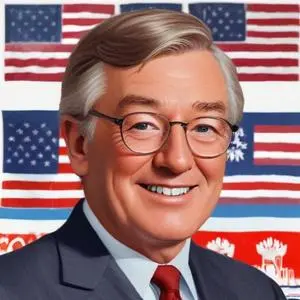
A renowned sociologist and politician who served as the 12th United States Ambassador to the United Nations, known for his work on social issues and foreign policy. He was a key figure in shaping US policy on poverty, race, and international relations.
Daniel Patrick Moynihan, the renowned American politician and diplomat, is best known for his provocative Moynihan Report on black poverty in 1965 and his four-term stint as a United States Senator from New York. As a scholar, statesman, and public intellectual, Moynihan left an indelible mark on the trajectory of American politics, foreign policy, and social reform.
Born on March 16, 1927, in Tulsa, Oklahoma, Moynihan's early life was marked by a series of moves, eventually settling in New York City. After serving in the Navy, he earned a Ph.D. in history from Tufts University, which laid the foundation for his future academic and political pursuits.
Moynihan's entry into politics began with his work on the staff of New York Governor W. Averell Harriman, followed by his appointment as an Assistant Secretary of Labor under Presidents John F. Kennedy and Lyndon B. Johnson. This period saw him play a crucial role in shaping the War on Poverty, a cornerstone of Johnson's Great Society program.
In 1965, Moynihan published his seminal report, "The Negro Family: The Case for National Action," which sparked a national conversation on the roots of black poverty. The report's findings, which emphasized the breakdown of the African American family structure as a primary cause of poverty, generated both praise and criticism. While some hailed Moynihan's courage in tackling a sensitive subject, others accused him of blaming the victims of racism and perpetuating stereotypes.
In 1969, Moynihan joined President Richard Nixon's administration as an Assistant to the President for Domestic Policy, later becoming Counselor to the President. His diplomatic career further blossomed with his appointment as United States Ambassador to India in 1973 and, subsequently, as United States Ambassador to the United Nations in 1975.
In 1976, Moynihan was elected to the United States Senate, where he served for four terms until 2001. During his tenure, he chaired the Senate Environment Committee and the Senate Finance Committee, distinguishing himself as a vocal critic of President Ronald Reagan's foreign policy and a fierce opponent of President Bill Clinton's health care plan.
Moynihan's willingness to buck party lines and challenge liberal orthodoxy earned him a reputation as a maverick. He opposed welfare reform in the 1990s and voted against the Defense of Marriage Act, demonstrating an independence that resonated with constituents and colleagues alike.
Daniel Patrick Moynihan's legacy extends far beyond his notable policy initiatives and public service. As a scholar, politician, and diplomat, he exemplified a commitment to intellectual honesty, moral courage, and public integrity. His refusal to conform to partisan ideologies or political expediency has inspired generations of public servants and policymakers.
"Everyone is entitled to his own opinion, but not to his own facts."
"The central conservative truth is that it is culture, not politics, that determines the success of a society. The central liberal truth is that politics can change a culture and save it from itself."
Daniel Patrick Moynihan's remarkable life, marked by trailblazing policy initiatives, diplomatic triumphs, and an unwavering commitment to public service, serves as a testament to the power of principle-driven leadership and the enduring impact of a single individual on the trajectory of American history.
Born in 1917
The 35th President of the United States was a charismatic leader who navigated the country through the Cuban Missile Crisis and advocated for civil rights, leaving a lasting legacy in American politics.
Born in 1908
The 36th President of the United States, a skilled politician and leader, played a crucial role in passing landmark civil rights legislation, including the Civil Rights Act and Voting Rights Act.
Born in 1913
The 37th President of the United States, a polarizing figure who led the country through significant domestic and foreign policy changes, infamous for his involvement in the Watergate scandal.
Born in 1913
The 38th President of the United States, a former football star and lawyer, is known for being the first vice president to assume the presidency under the 25th Amendment and for his controversial pardon of Richard Nixon. He's also remembered for his humble and accidental rise to the presidency.
Born in 1924
A naval officer turned politician who served as the 39th President of the United States, known for his commitment to human rights and social justice, and awarded the Nobel Peace Prize in 2002.
Born in 1911
The charismatic leader who championed conservative policies, helped end the Cold War, and is often credited with restoring American pride and optimism. He's also remembered for his folksy, actor-honed communication style.
Born in 1924
The 41st President of the United States, a decorated war hero and skilled diplomat, led the country through the end of the Cold War and Gulf War. He's known for his foreign policy expertise and "kinder, gentler nation" vision.
80 Years Old
The 42nd President of the United States, a charismatic leader who reformed healthcare and economy, and infamous for his scandals.
