


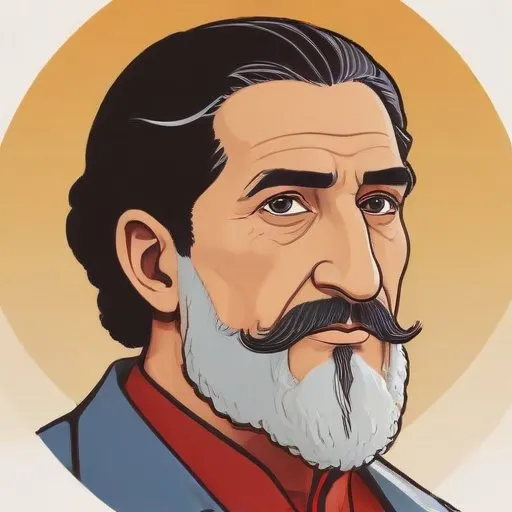
A pioneering Armenian poet and educator who played a crucial role in shaping Armenian literature and culture through his influential works and teachings.
Daniel Varoujan, an enigmatic poet of the early 20th century, left an indelible mark on Armenian literature and culture. At the tender age of 31, when his star was on the ascendant, he fell victim to the brutal Armenian Genocide orchestrated by the Young Turk government, an untimely silencing of a promising voice.
Born Daniel Tchboukkiarian in the picturesque village of Prknig (now known as Çayboyu), near the town of Sivas in Turkey, Varoujan's curiosity and thirst for knowledge led him to attend the local school. In 1896, amidst the tumultuous backdrop of the Hamidian massacres, he was sent to Istanbul to further his education at the prestigious Mkhitarian school.
His intellectual pursuits continued at the Collegio Armeno Moorat-Raphael in Venice, where he refined his understanding of literature, sociology, and economics. In 1905, he enrolled at Ghent University in Belgium, a hub of intellectual fervor, further solidifying his grasp on the humanities.
In 1914, Varoujan co-founded the Mehean literary group, a revolutionary collective that sought to revive Armenian literature and art. Alongside fellow visionaries Gostan Zarian, Hagop Oshagan, Aharon Dadourian, and Kegham Parseghian, he strove to create a temple of art, a sanctuary where fragmented and scattered Armenian voices could converge.
The Mehean manifesto declared the group's intention to awaken a "spiritually scattered nation" and unlock its creative potential. However, internal debates raged on, as members struggled to reconcile the ends and means of their movement. Varoujan, deeply influenced by Nietzschean ideas, advocated for art as a means to achieve universal creative expression, rather than merely serving as a tool to center the nation.
In 1915, Varoujan's life took a catastrophic turn when he was deported from Constantinople, along with thousands of Armenians, during the forced relocation and massacre orchestrated by the Ottoman government. His promising literary career was brutally cut short, leaving behind a body of work that was both powerful and poignant.
Despite his untimely demise, Varoujan's vision for an Armenian renaissance continued to inspire generations of writers, artists, and intellectuals. His poetry, characterized by its lyricism, depth, and emotional intensity, remains a testament to his boundless talent and creative genius.
As the world continues to wrestle with the complexities of identity, culture, and nationhood, Varoujan's legacy serves as a powerful reminder of the transformative power of art and literature. His courage, conviction, and creative vision have left an indelible mark on Armenian culture, a beacon of hope in the face of tragedy and devastation.
Though Varoujan's life was tragically cut short, his contributions to Armenian literature and culture have been posthumously recognized and celebrated. His legacy continues to inspire new generations of writers, artists, and thinkers.
Born in 1897
A prominent Armenian poet and activist who used his literary works to promote social justice and independence, earning him the title "the people's poet".
Born in 1869
A renowned Armenian-Russian poet and author, celebrated for his vivid storytelling and poignant poetry that explores the human condition, love, and social justice.
Born in 1878
Armenian poet and activist who wrote extensively on Armenian identity and independence, and was a key figure in the Armenian nationalist movement.
