


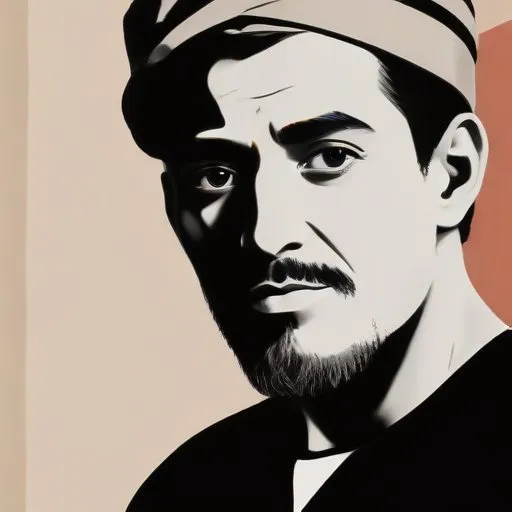
A pioneering Lebanese artist celebrated for his vibrant, expressive paintings that blended Middle Eastern and European influences, capturing the essence of his homeland's cultural heritage.
Drawing upon the richness of Lebanese culture and the grandeur of Renaissance art, Daoud Corm (1852-1930) etched his name in the annals of history as an influential painter, teacher, and mentor. His artistic prowess earned him recognition across the Arab world and beyond, making him the father of Lebanese painting.
Early life in Ghosta, Mount Lebanon, nurtured Corm's artistic inclinations. His father, Shamun Hokayem, a polyglot and accomplished polymath, instilled in him a love for learning and the arts. Corm's fascination with the human form led him to enroll at the Accademia di San Luca in Rome, where he honed his skills under the tutelage of Italian court painter Roberto Bompiani.
Corm's five-year sojourn in Italy (1870-1875) exposed him to the masterpieces of Renaissance artists, an influence that permeated his later work. The artist's palette was further enriched by his fascination with Arab culture and his relationships with prominent figures, including Khalil Gibran, Khalil Saleeby, and Habib Srour.
Upon his return to Lebanon, Corm focused on capturing the essence of Arab culture through his portraits. His subjects included prominent figures such as Abbas II of Egypt (1894) and Pope Pius IX (1875), a testament to his artistic prowess. His paintings adorn churches across Lebanon, Syria, Egypt, and Palestine, cementing his status as a religious painter.
In 1912, Corm founded Maison d'Art, an art supply store and studio in Beirut. This venture not only reflected his commitment to art education but also signified a growing public interest in art appreciation and creation.
Corm's artistic mastery earned him international recognition. He exhibited his work at prestigious events such as the 1889 Versailles Exhibition in France and the 1900 Paris Exhibition, where he received the Prize of Honor of Excellence. Additionally, he was awarded the Lebanese Order of Merit and the Ottoman Medal of Glory.
Daoud Corm's artistic contributions continue to inspire generations of artists, art enthusiasts, and scholars. His legacy is a testament to the power of art to transcend boundaries and evoke emotions. As a painter, teacher, and mentor, Corm's influence extends far beyond his own work, leaving an indelible mark on the cultural landscape of Lebanon and the Arab world.
Drawing from the soul, Daoud Corm's artistry continues to captivate and inspire, a testament to the power of creativity and the importance of preserving cultural heritage.
Born in 1916
A pioneering female artist of the Middle East, she merged Islamic art with modernist styles, creating innovative sculptures and paintings that explored geometry, abstraction, and spirituality.
Born in 1866
A pioneer of abstract art, creating vibrant, expressive works that explored the emotional and spiritual properties of color, and wrote extensively on art theory.
Born in 1881
A pioneering artist who transformed modern art with pioneering Cubist works, creating a new visual language that continues to inspire and influence art, design, and culture.
Born in 1904
A renowned surrealist master of bizarre, dream-like paintings and sculptures that blur reality and fantasy, known for iconic works like "The Persistence of Memory" and "The Elephants".
Born in 1869
A pioneering artist who revolutionized modern art with bold, expressive, and colorful works that blurred the lines between painting and sculpture, creating a new language of form and color.
Born in 1893
A renowned Spanish artist, famous for his vibrant, dreamlike paintings and sculptures that blended abstraction and surrealism, creating a unique visual language. His works often featured bold colors, biomorphic forms, and a sense of playfulness.
Born in 1898
A Belgian surrealist painter who challenged perceptions by depicting everyday objects in unexpected contexts, creating thought-provoking and witty visual paradoxes.
