


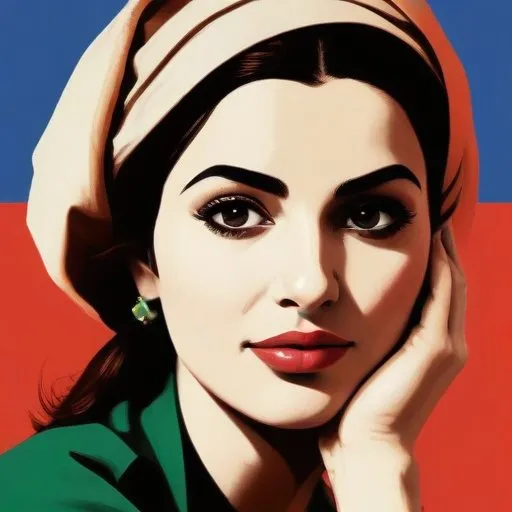
A pioneering female artist of the Middle East, she merged Islamic art with modernist styles, creating innovative sculptures and paintings that explored geometry, abstraction, and spirituality.
Saloua Raouda Choucair, a Lebanese painter and sculptor, is renowned for her groundbreaking contributions to the modern art movement in the Middle East. Through her innovative and eclectic style, she has left an indelible mark on the art world, blending traditional Arabic calligraphy with modernist abstraction.
Born on June 24, 1916, in Ain El Mraisseh, Lebanon, Choucair came from a family of intellectuals and creatives. Her father, Salim Rawda, was an expatriate in Australia who traded herbs and wrote manuscripts on their medicinal values. Her mother, Zalfa Amin Najjar, was a well-educated poet and orator who was awarded a medallion from Brummana High School upon turning 100.
Choucair's early life was marked by tragedy, with her father's death in 1917. Her mother, widowed at a young age, raised three children on her own, instilling in them a love for art and education. Choucair's artistic talent was evident from a young age, and she produced numerous handcrafted objects, designed school posters, and even created caricatures of her teachers.
Choucair's artistic journey began in the 1940s, when she started experimenting with various mediums, including painting, sculpture, and ceramics. Her work was heavily influenced by Arabic calligraphy, Islamic art, and geometric abstraction. She was particularly drawn to the concept of " Islamic Unity," which emphasized the unity and harmony of all forms of art.
In the 1950s, Choucair's work gained international recognition, with exhibitions in Paris, Rome, and Beirut. Her unique style, which blended traditional and modernist elements, captivated audiences and critics alike. She was hailed as a pioneer of Lebanese modernism, and her work paved the way for future generations of Middle Eastern artists.
Choucair's artistic philosophy was deeply rooted in her cultural heritage. She believed that art should be a reflection of one's cultural identity, and that it should serve as a bridge between tradition and modernity. Through her work, she sought to promote cross-cultural understanding and exchange.
Choucair was also a strong advocate for women's rights and education. She believed that education was the key to empowerment, and that women should be given equal opportunities to pursue their passions and talents.
Choucair's contributions to the art world were recognized with numerous awards and honors. She was awarded the Lebanese National Order of the Cedar in 1988, and the Palestine Order of Culture and Science in 1997. Her work is held in high esteem by museums and collectors around the world, and is considered a national treasure in Lebanon.
Saloua Raouda Choucair's legacy extends far beyond her own artistic achievements. She has inspired generations of artists, designers, and cultural activists to explore the rich cultural heritage of the Middle East. Her work has also promoted cross-cultural understanding and exchange, fostering greater appreciation and respect for the region's rich artistic traditions.
Today, Choucair's work can be found in museums and private collections around the world, including the Sursock Museum in Beirut, the Institut du Monde Arabe in Paris, and the British Museum in London. Her legacy continues to inspire and influence artists, designers, and cultural activists, ensuring that her art and message remain relevant and impactful for generations to come.
97 Years Old
A pioneering abstract expressionist artist, known for her innovative "soak-stain" technique, which involved pouring thinned paint onto raw canvas to create vibrant, lyrical works. Her style blurred the lines between painting and printmaking.
Born in 1910
A prominent figure in the abstract expressionist movement, known for bold, expressive brushstrokes and vibrant colors that evoked intense emotions.
Born in 1904
A pioneering abstract expressionist, he revolutionized modern art with bold, expressive brushstrokes and vibrant colors, creating dynamic, emotive pieces that continue to inspire.
Born in 1912
Pioneering abstract expressionist artist who splattered and dripped paint to create dynamic, emotive works that redefined modern art. Known for chaotic, intricate pieces that evoke raw emotion.
Born in 1903
A pioneer of abstract expressionism, creating bold, rectangular color fields that evoke emotions and spark introspection. His works are a testament to the power of art to transcend language and culture.
Born in 1905
A pioneer of Abstract Expressionism, creating bold, color-field paintings that evoke emotions and spirituality. His iconic "zip" paintings feature vibrant, vertical stripes that seem to pulse with energy.
Born in 1904
A pioneering abstract expressionist, creating large-scale, gestural paintings that explored the human experience and the American West. Known for his bold, expressive brushstrokes and vibrant color palette.
Born in 1925
A pioneer of pop art, combining found objects and images to create innovative, thought-provoking works that blurred the lines between art and everyday life.
