


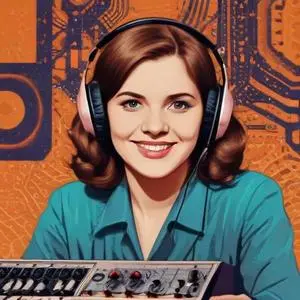
Pioneering electronic music composer and inventor of the Oramics system, a technique for creating electronic sounds through drawings. She was a key figure in the development of British electronic music.
Oram's career at the BBC began in 1942 as a Junior Studio Engineer and music balancer. However, it was her experimentation with tape recorders and sound effects that led to her true innovations. She developed the Oramics technique for graphical sound, which allowed her to create complex electronic music through a visual representation of sound waves.
One of her most notable works is the uncredited scoring for the 1961 film The Innocents, which showcased her pioneering use of electronic sound in film music. Her book, An Individual Note of Music, Sound and Electronics (1971), explored philosophical themes related to acoustics and electronic composition.
Oram's work was deeply rooted in her philosophical beliefs about the relationship between sound, music, and technology. She believed that electronic music could be a powerful tool for exploring the human experience and pushing the boundaries of artistic expression.
Through her work, Oram challenged traditional notions of music composition and performance, advocating for a more experimental and avant-garde approach. Her Oramics technique embodied this spirit of innovation, allowing her to create complex sounds and textures that were previously unimaginable.
Oram's contributions to electronic music have had a lasting impact on modern society. Her pioneering work paved the way for future generations of electronic musicians, composers, and producers. Today, her influence can be heard in a wide range of musical genres, from ambient and experimental to pop and rock.
Despite facing obstacles as a woman in a male-dominated field, Oram received recognition for her groundbreaking work. She was the first woman to independently direct and set up a personal electronic music studio, and the first woman to design and construct an electronic musical instrument.
Daphne Oram's legacy extends far beyond her own lifetime. She inspired a generation of composers and musicians, and her work continues to influence the development of electronic music today. As a true pioneer, Oram's innovative spirit and artistic vision have left an indelible mark on the music world.
Daphne Oram's life and work serve as a powerful inspiration to anyone who has ever felt the urge to push boundaries and challenge conventions. Her pioneering spirit, innovative approach, and dedication to her craft continue to inspire generations of musicians, composers, and artists.
As a true trailblazer, Oram's legacy reminds us that even the most seemingly impossible feats can be achieved through determination, creativity, and a willingness to take risks.
89 Years Old
A pioneering electronic music composer and arranger who transformed the BBC Radiophonic Workshop, creating iconic soundscapes for Doctor Who and beyond.
78 Years Old
A pioneer of electronic music, he's a renowned producer and musician who has collaborated with iconic artists like David Bowie and U2, and is credited with shaping the sound of ambient music.
97 Years Old
A pioneer of electronic and avant-garde music, this composer pushed boundaries with unconventional sounds and performances, influencing generations of musicians and artists.
