


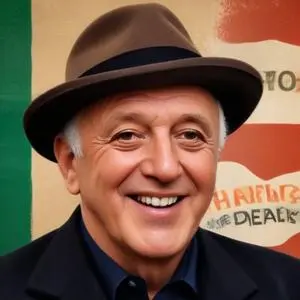
A renowned Italian playwright, actor, and director known for his provocative and humorous works that critique social and political issues, often incorporating satire and absurdity.
Dario Fo, the renowned Italian playwright, actor, theatre director, and songwriter, is best known for his provocative and politically charged works that have captivated audiences worldwide. With a career spanning over six decades, Fo's commitment to social activism and his innovative approach to theatre have earned him the 1997 Nobel Prize in Literature.
Born on March 24, 1926, in Leggiuno, Italy, Fo's artistic journey began at an early age. He studied art and architecture in Milan before turning to theatre, where he honed his skills as an actor, playwright, and director. Fo's work often blended politics and satire, tackling issues like corruption, war, and social inequality.
Improvisation played a significant role in Fo's work, drawing inspiration from the medieval giullari and the ancient Italian style of commedia dell'arte. This approach allowed him to create dynamic and interactive performances that resonated with his audiences. Fo's use of improvisation also enabled him to respond to current events and social issues, making his work both timely and timeless.
Fo's contributions to literature and theatre have been recognized with numerous awards and honors. In addition to the Nobel Prize in Literature, he received the Sonning Prize in 1981, the Obie Award in 1986, and the Eduardo De Filippo Prize in 2000. Fo's work has been translated into over 30 languages and has been performed in more than 40 countries worldwide.
Fo's most famous solo piece, Mistero Buffo, has been performed across Europe, Asia, Canada, and Latin America over a 30-year period. This production has been denounced by Cardinal Ugo Poletti as the most blasphemous show in the history of television, demonstrating Fo's willingness to challenge religious and political institutions.
Other notable works include:
Fo's work is deeply rooted in his commitment to social justice and his belief in the power of theatre to inspire change. He has been an outspoken critic of capitalism, imperialism, and religious dogma, using his platform to challenge oppressive systems and institutions.
Fo's impact on modern society is multifaceted. His work has inspired a generation of playwrights, actors, and activists, encouraging them to use their craft as a means of social commentary. Fo's commitment to improvisation has also influenced the development of experimental theatre, paving the way for new forms of performance art.
Dario Fo's legacy extends far beyond his own body of work. He has left an indelible mark on the world of theatre, inspiring a new wave of artists to engage with social and political issues. As a Nobel laureate, Fo's work has reached a global audience, cementing his place as one of the most important and influential playwrights of the 20th century.
Born in 1922
Leader of the Italian Communist Party who implemented a policy of Eurocommunism, seeking to reform the party and distance it from Soviet influence.
Born in 1922
A provocative and influential artist who explored the intersection of politics, religion, and sexuality through his films, which often featured vivid imagery and unflinching social commentary.
93 Years Old
A renowned Italian actor, known for his intense, brooding performances in Spaghetti Westerns and political dramas, often playing complex, morally ambiguous characters.
Born in 1922
A renowned Italian actor, director, and screenwriter who brought complexity and nuance to his characters, starring in over 100 films and winning numerous awards. He's a cultural icon in Italy, symbolizing the country's cinematic golden age.
Born in 1924
A renowned actor and singer, starring in over 150 films, including iconic Italian neorealist classics and international productions, earning him numerous awards and nominations.
Born in 1922
A renowned Italian actor, comedian, and director, known for his witty humor and memorable performances in classic Italian comedies.
