


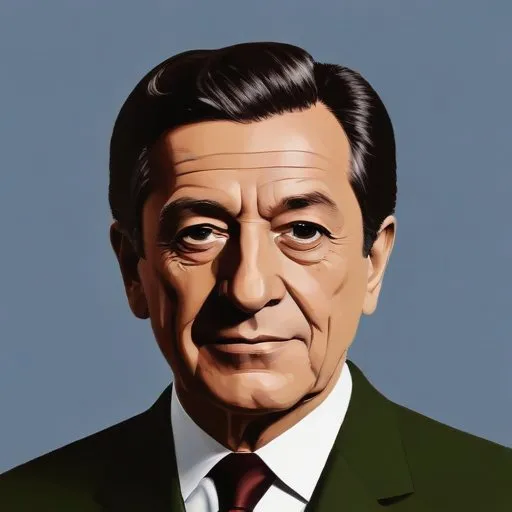
Leader of the Italian Communist Party who implemented a policy of Eurocommunism, seeking to reform the party and distance it from Soviet influence.
Enrico Berlinguer is synonymous with Eurocommunism, a revolutionary idea that reshaped the political landscape of Western Europe in the 1970s. As the secretary of the Italian Communist Party (PCI) from 1972 until his death in 1984, Berlinguer led the party to unprecedented electoral success, while pursuing a moderate line that distanced the PCI from the Soviet Union's influence.
Born on May 25, 1922, in Sassari, Sardinia, Berlinguer came from a middle-class family with a strong socialist tradition. His father, Mario, was a deputy and later senator. Berlinguer's political journey began in his youth, as he led the PCI's youth wing, the Italian Communist Youth Federation (FGCI), in his hometown and later at the national level from 1949 to 1956. In 1968, he was elected to the Chamber of Deputies, marking the beginning of his illustrious parliamentary career.
Berlinguer's ascent to the top of the PCI hierarchy came in 1972, when he became the party's national secretary. During his leadership, the PCI experienced unprecedented electoral success, with the party's vote share peaking in 1976. Berlinguer's strategy, later dubbed Eurocommunism, sought to reposition the PCI within Italian politics, pursuing a moderate line that advocated for accommodation and national unity. This approach diverged from the Soviet Union's influence, cementing Berlinguer's reputation as a reformist leader.
Berlinguer's leadership and Eurocommunist ideology had far-reaching consequences, both nationally and internationally. The PCI's electoral successes inspired similar reformist movements in Western Europe, such as the Communist Party of Spain and the French Communist Party. Berlinguer's legacy continues to shape Italian politics, with his emphasis on national unity and democratic socialism remaining core values for many left-wing parties.
Berlinguer was known for his humility and simplicity, earning him widespread respect among Italians. He married Letizia Laurenti in 1946, with whom he had four children. Berlinguer's untimely death on June 11, 1984, was met with widespread mourning, as Italy lost a towering figure in its political landscape.
"We must learn to live together, not to make war on each other." - Enrico Berlinguer
"The PCI is not a party of the proletariat, but a party of the people." - Enrico Berlinguer
Berlinguer's leadership coincided with a tumultuous period in Italian history, marked by the "Years of Lead" (1968-1982) and social conflicts like the "Hot Autumn" of 1969-1970. Despite these challenges, Berlinguer's PCI remained a beacon of hope for many Italians, offering a vision of democratic socialism that eschewed authoritarianism. Today, Berlinguer's legacy continues to inspire left-wing politicians and activists across Europe, serving as a testament to the power of reformist ideology.
Born in 1916
The 39th Prime Minister of Italy, a prominent figure in post-war Italian politics, known for his efforts to establish a historic compromise between Christian Democrats and Communists. He was kidnapped and murdered by the Red Brigades in 1978.
98 Years Old
An Italian academic and politician who served as the 8th President of Italy, known for his role in shaping the country's politics and foreign policy during the Cold War era. He was a key figure in Italy's transition from a monarchy to a republic.
Born in 1925
A prominent Italian journalist and politician who served as Prime Minister of Italy, known for his leadership during a tumultuous period in the country's history. He played a key role in shaping Italy's post-war politics and economy.
92 Years Old
The 45th Prime Minister of Italy, a charismatic leader who dominated Italian politics in the 1980s, known for his flamboyant style and corruption scandals. He was a key figure in European politics during the Cold War era.
Born in 1896
A courageous anti-fascist journalist and politician who served as President of Italy, known for his strong democratic values and commitment to social justice.
Born in 1919
A dominant figure in Italian politics, serving as Prime Minister seven times, known for his cunning and controversial leadership style. He was a key player in shaping Italy's post-war politics.
Born in 1908
Italian journalist and politician who served as Prime Minister of Italy six times, playing a key role in shaping the country's post-war politics and economy. He was a dominant figure in Italian politics for over three decades.
