


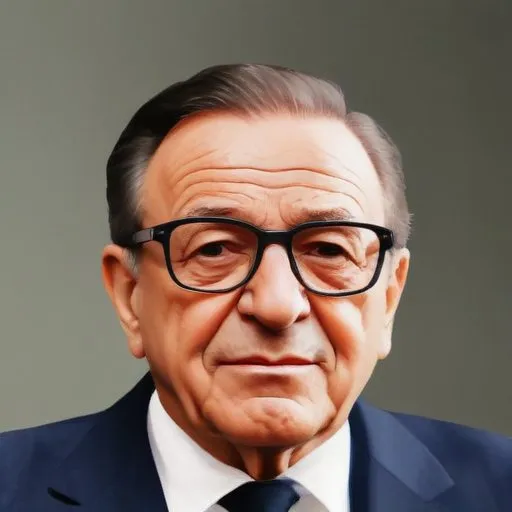
A dominant figure in Italian politics, serving as Prime Minister seven times, known for his cunning and controversial leadership style. He was a key player in shaping Italy's post-war politics.
Giulio Andreotti, a name synonymous with Italian politics, served as the Prime Minister of Italy in seven governments from 1972 to 1992, making him the sixth-longest-serving Prime Minister since the Italian unification and the second-longest-serving post-war Prime Minister. He was a force to be reckoned with, leading the Christian Democracy party and its right-wing, and was widely regarded as the most powerful and prominent politician of the First Republic.
Andreotti's political career spanned over 40 years, during which he occupied all the major offices of state. He began as a protégé of Alcide De Gasperi, achieving cabinet rank at a young age and quickly becoming a reassuring figure for the civil service, business community, and Vatican.
In foreign policy, Andreotti played a pivotal role in guiding Italy's integration into the European Union, establishing closer relations with the Arab world and paving the way for Italy's economic growth. His efforts helped transform Italy from a largely rural country to the world's fifth-largest economy.
Andreotti's reign was not without controversy. While his admirers saw him as a masterful mediator of political and social contradictions, his critics accused him of perpetuating a system of patronage that led to widespread corruption. He was also criticized for his close ties with the Vatican and his unwavering support for a capitalist structure, which some saw as detrimental to the country's social and economic progress.
In the twilight of his career, Andreotti faced criminal prosecutions and was charged with colluding with the notorious Cosa Nostra. Although courts ultimately proved his links with the organization until 1980, the case was closed due to past statutes of limitations. The allegations cast a shadow over his legacy, but his impact on Italian politics remains undeniable.
Love him or loathe him, Andreotti left an indelible mark on Italian politics and history. He played a crucial role in shaping Italy's post-war identity, navigating the country through tumultuous times, and setting the stage for its future growth. His legacy continues to be felt, with his influence still resonating in the halls of power today.
Andreotti was known for his charm and wit, often using humor to defuse tense situations. He was a devout Catholic and maintained close ties with the Vatican throughout his career. Despite his later-life controversies, he remained a respected figure in Italian politics until his passing in 2013.
"Power is a disease one has no soon as one wants to."
Giulio Andreotti's life and legacy serve as a testament to the complexities of politics and power. His story is a reminder that even the most influential figures are not immune to controversy, and that true greatness is often shrouded in nuance and complexity.
Born in 1916
The 39th Prime Minister of Italy, a prominent figure in post-war Italian politics, known for his efforts to establish a historic compromise between Christian Democrats and Communists. He was kidnapped and murdered by the Red Brigades in 1978.
98 Years Old
An Italian academic and politician who served as the 8th President of Italy, known for his role in shaping the country's politics and foreign policy during the Cold War era. He was a key figure in Italy's transition from a monarchy to a republic.
92 Years Old
The 45th Prime Minister of Italy, a charismatic leader who dominated Italian politics in the 1980s, known for his flamboyant style and corruption scandals. He was a key figure in European politics during the Cold War era.
90 Years Old
A billionaire media mogul who dominated Italian politics for decades, known for his flamboyant personality and numerous scandals.
Born in 1918
The 9th President of Italy, a lawyer and politician who played a key role in shaping the country's post-war politics and served as a senator for life. He's remembered for his strong stance against organized crime and corruption.
Born in 1925
A prominent Italian journalist and politician who served as Prime Minister of Italy, known for his leadership during a tumultuous period in the country's history. He played a key role in shaping Italy's post-war politics and economy.
Born in 1908
Italian journalist and politician who served as Prime Minister of Italy six times, playing a key role in shaping the country's post-war politics and economy. He was a dominant figure in Italian politics for over three decades.
Born in 1881
Italian journalist and politician who served as the 30th Prime Minister of Italy, leading the country's post-WWII reconstruction and European integration efforts. He's known for his key role in shaping modern Italy's politics and economy.
