


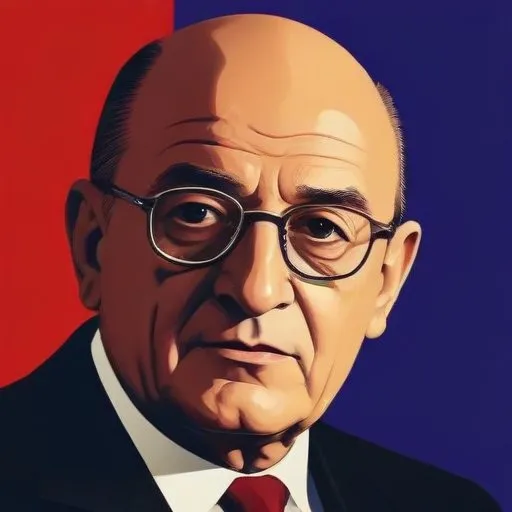
The 45th Prime Minister of Italy, a charismatic leader who dominated Italian politics in the 1980s, known for his flamboyant style and corruption scandals. He was a key figure in European politics during the Cold War era.
Bettino Craxi, the 45th Prime Minister of Italy, was a prominent figure in Italian politics, leading the Italian Socialist Party (PSI) from 1976 to 1993 and serving as Prime Minister from 1983 to 1987. He is remembered as one of the most powerful and influential politicians of the First Italian Republic, known for his assertive foreign policy and his role in shaping Italy's political landscape.
Born on February 24, 1934, in Milan, Italy, Craxi was the son of Vittorio Craxi, a Sicilian lawyer and antifascist who was persecuted by the regime of Benito Mussolini. This early exposure to politics and the struggle against fascism would shape Craxi's future political ideology and career.
Craxi's rise to power began in the 1960s, when he became involved in local politics in Milan. He quickly rose through the ranks of the Italian Socialist Party (PSI), becoming the party's secretary in 1976. Under his leadership, the PSI underwent significant reforms, moving away from its traditional Marxist roots and embracing a more liberal, social democratic ideology.
In 1983, Craxi became the first PSI member to become Prime Minister of Italy, a position he held until 1987. During his tenure, he implemented several significant reforms, including the introduction of a new electoral law, the reform of the pension system, and the liberalization of the economy.
Craxi's foreign policy was marked by assertiveness and a willingness to challenge the status quo. He was a strong supporter of Palestine and was critical of the United States' policies in the region. He also maintained strong relationships with leaders of the Western European left, including François Mitterrand, Felipe González, and Andreas Papandreou.
Craxi's career was not without controversy. He was involved in investigations conducted by the Mani pulite judges in Milan, which led to his conviction for political corruption and illicit financing of the PSI. Despite this, Craxi remains a significant figure in Italian politics, remembered for his leadership and vision.
Craxi was known for his physical size, earning him the nickname "il Cinghialone" (The Big Boar) from his longtime ally and rival, DC leader Giulio Andreotti.
Craxi's legacy extends beyond Italian politics. He played a significant role in shaping Western European socialism and was a key figure in the development of the European Union. His foreign policy, which prioritized assertiveness and independence, continues to influence Italian politics today.
Craxi's leadership style and political ideology are often compared to those of other prominent European socialist leaders of the time, including François Mitterrand and Felipe González. While sharing similarities with these leaders, Craxi's unique approach to politics and his commitment to social democracy set him apart.
Craxi's political ideology was rooted in social democracy, which emphasized the importance of social welfare, individual freedom, and economic equality. He believed in the importance of a strong state and the need for government intervention in the economy to protect the rights of workers and the marginalized.
This visual timeline highlights key milestones in Craxi's life and career:

Bettino Craxi's legacy continues to shape Italian politics and beyond. His commitment to social democracy, his assertive foreign policy, and his leadership of the Italian Socialist Party have left a lasting impact on modern society.
90 Years Old
A billionaire media mogul who dominated Italian politics for decades, known for his flamboyant personality and numerous scandals.
Born in 1919
A dominant figure in Italian politics, serving as Prime Minister seven times, known for his cunning and controversial leadership style. He was a key player in shaping Italy's post-war politics.
98 Years Old
An Italian academic and politician who served as the 8th President of Italy, known for his role in shaping the country's politics and foreign policy during the Cold War era. He was a key figure in Italy's transition from a monarchy to a republic.
Born in 1916
The 39th Prime Minister of Italy, a prominent figure in post-war Italian politics, known for his efforts to establish a historic compromise between Christian Democrats and Communists. He was kidnapped and murdered by the Red Brigades in 1978.
Born in 1922
Leader of the Italian Communist Party who implemented a policy of Eurocommunism, seeking to reform the party and distance it from Soviet influence.
Born in 1925
A prominent Italian journalist and politician who served as Prime Minister of Italy, known for his leadership during a tumultuous period in the country's history. He played a key role in shaping Italy's post-war politics and economy.
Born in 1908
Italian journalist and politician who served as Prime Minister of Italy six times, playing a key role in shaping the country's post-war politics and economy. He was a dominant figure in Italian politics for over three decades.
98 Years Old
Led Italy's government during a tumultuous period, implementing economic reforms and navigating international relations. He's also known for his role in shaping the country's European integration policies.
