


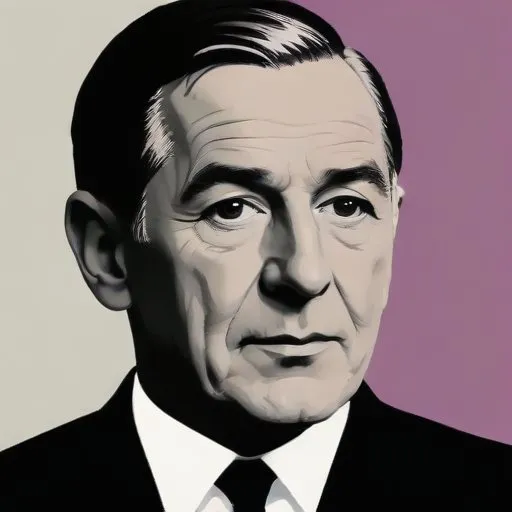
A British businessman and politician who served as Secretary of State for Education, known for his efforts to reform the education system and promote vocational training. He played a significant role in shaping the country's education policy during his tenure.
David Eccles, 1st Viscount Eccles, was a distinguished English Conservative politician who left an indelible mark on the British political landscape. He is best known for his storied career, which spanned over three decades, and his instrumental role in shaping the country's education, economy, and cultural heritage.
Born on September 18, 1904, Eccles received his education at Winchester College and New College, Oxford, where he earned a second-class degree in Philosophy, Politics, and Economics (PPE). His academic pursuits laid the foundation for his future success in politics and beyond.
Eccles' political journey began in 1943, when he was elected as the Member of Parliament (MP) for Chippenham in a wartime by-election. He held this seat until 1962, serving under the Conservative administrations of Winston Churchill, Anthony Eden, and Harold Macmillan.
During his tenure, Eccles held various ministerial positions, including Minister of Works (1951-1954), Minister of Education (1954-1957 and 1959-1962), and President of the Board of Trade (1957-1959). In 1953, he played a crucial role in organizing the Coronation of Queen Elizabeth II, earning him an appointment as Knight Commander of the Royal Victorian Order (KCVO).
In 1962, Eccles was elevated to the peerage as Baron Eccles, of Chute in the County of Wiltshire, and two years later, he was created Viscount Eccles, of Chute in the County of Wiltshire.
In 1970, Eccles returned to government as Paymaster General and Minister for the Arts under Edward Heath's administration. During this tenure, he clashed with the Chairman of the Arts Council of Great Britain, Arnold Goodman, over the funding of controversial plays and exhibitions. Eccles also introduced mandatory admission charges at public museums and galleries, sparking controversy and debate.
Eccles married the Hon. Sybil Frances Dawson, daughter of Bertrand Dawson, 1st Viscount Dawson of Penn, in 1929. The couple had two sons and two daughters together.
Throughout his life, Eccles received several honorary degrees, including a Doctor of Science (DSc) from Loughborough University in 1966 and an Honorary Science Doctorate from the University of Bath in 1972.
David Eccles, 1st Viscount Eccles, passed away on February 24, 1999, leaving behind a rich legacy as a dedicated public servant, champion of the arts, and stalwart of British politics.
"The arts are not a luxury, but a necessity. They are the very fabric of our society, and it is our duty to preserve and promote them."
"The purpose of education is not merely to impart knowledge, but to instill values, foster critical thinking, and inspire creativity."
David Eccles, 1st Viscount Eccles, will be remembered as a trailblazing politician who dedicated his life to public service, education, and the arts. His contributions continue to shape British politics, education, and culture, inspiring future generations to follow in his footsteps.
Born in 1894
A British politician who served as Prime Minister from 1957 to 1963, known for leading the country through a period of economic prosperity and decolonization.
Born in 1903
A British aristocrat who served as Prime Minister from 1963 to 1964, known for his brief tenure and aristocratic background.
Born in 1916
The Prime Minister who led the UK into the European Economic Community (EEC) and navigated the country through a period of economic and industrial turmoil. He's also known for his diplomatic efforts, particularly in regards to the Cold War.
Born in 1912
A British politician who served as Prime Minister from 1976 to 1979, known for his efforts to stabilize the economy and navigate the country through a period of industrial unrest.
Born in 1885
Won the 1952 Olympic Games marathon in Helsinki, Finland, and held the world record in the marathon from 1952 to 1953.
Born in 1920
A British politician who served as President of the European Commission, known for his progressive reforms and efforts to create a more unified Europe. He played a key role in shaping the EU's modern identity.
Born in 1917
A British politician who served as Chancellor of the Exchequer from 1974 to 1979, known for his efforts to stabilize the UK's economy during a period of high inflation and economic crisis.
