


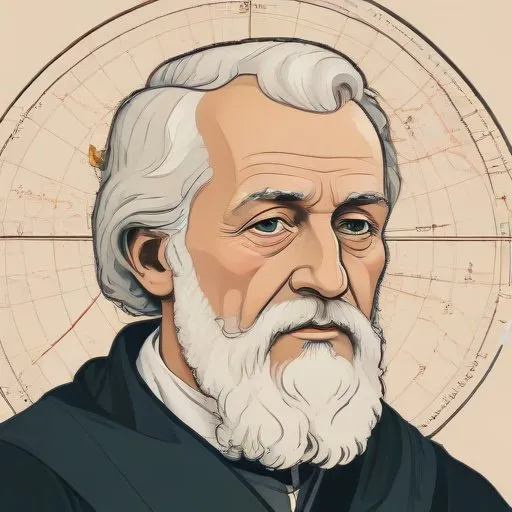
A 16th-century theologian, cartographer, and astronomer who made significant contributions to the field of astronomy, including the discovery of the first known variable star, Mira. He also created detailed maps of the Frisian Islands.
David Fabricius, a 16th-century German pastor, is renowned for his groundbreaking contributions to astronomy, particularly the discovery of the first known periodic variable star, Mira, and the observation of sunspots. These findings not only expanded humanity's understanding of the celestial realm but also marked the dawn of a new era in telescopic astronomy.
Fabricius was born on March 9, 1564, in Esens, Germany, and studied at the University of Helmstedt, where he developed a passion for astronomy. As a Protestant minister, he served in small towns near his birthplace, including Resterhafe and Osteel. His duties as a pastor did not deter him from pursuing his scientific interests, and he corresponded with prominent astronomers, such as Johannes Kepler.
In August 1596, Fabricius discovered Mira, a star that appeared to brighten and dim periodically. Initially, he thought it was a nova, a catastrophic stellar event. However, when the star brightened again in 1609, Fabricius realized that he had stumbled upon a new type of celestial phenomenon – a periodic variable star. This discovery revolutionized the field of astronomy, as it introduced the concept of recurring variability in stars.
Two years later, Fabricius and his son, Johannes, turned their telescopes toward the Sun, observing sunspots for the first time. Despite the challenges of direct solar observation, they developed camera obscura telescopy to study the solar disk, noting that the spots moved across the Sun's surface. This breakthrough marked the first confirmed observation of sunspots, a phenomenon that would later become crucial in understanding solar activity and its impact on the Earth.
Fabricius's discoveries had a profound impact on the development of astronomy, inspiring future generations of scientists to explore the mysteries of the universe. His work laid the foundation for the study of variable stars, stellar evolution, and solar physics. The Fabricius family's pioneering spirit and innovative use of telescopes paved the way for astronomers like Galileo Galilei, who built upon their discoveries to further our understanding of the cosmos.
Fabricius's work embodies the spirit of scientific inquiry and the pursuit of knowledge. His discoveries demonstrate the importance of observation, experimentation, and critical thinking in understanding the natural world. As a pastor, Fabricius's faith was intertwined with his scientific pursuits, illustrating the compatibility of spirituality and reason.
David Fabricius's remarkable achievements have left an indelible mark on the history of astronomy, inspiring generations to gaze up at the stars and contemplate the wonders of the universe.
Born in 1546
A 16th-century astronomer who made precise measurements of the stars and planets, laying the foundation for modern astronomy. His data helped Kepler discover planetary orbits.
Born in 1571
A 17th-century trailblazer who discovered the three laws of planetary motion, revolutionizing our understanding of the solar system. He's also credited with being a pioneer in the field of astrology.
Born in 1564
Pioneering astronomer, physicist, and mathematician who played a major role in the Scientific Revolution, making key discoveries that challenged Aristotelian views and laid the foundation for modern science.
Born in 1587
A 17th-century astronomer who discovered sunspots and published the first definitive book on the subject, making significant contributions to our understanding of the sun.
Born in 1738
A pioneering astronomer and musician who discovered Uranus and two of its moons, and also composed symphonies and concertos.
Born in 1750
First female astronomer to receive a salary, discovered several comets and double stars, and assisted her brother William in his astronomical observations.
Born in 1784
Developed the Bessel functions, a set of mathematical equations crucial for astronomy, navigation, and engineering, and made the first accurate measurement of a star's distance from Earth.
