


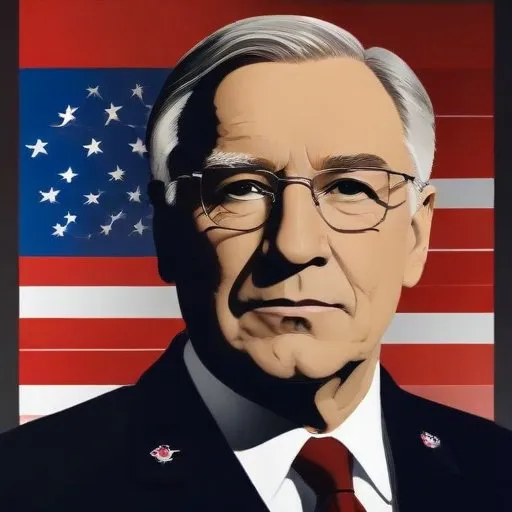
A decorated military commander and seasoned diplomat, he served as the United States' top representative to NATO, shaping international relations and security policies. His expertise helped navigate complex global issues.
David Manker Abshire, a renowned American diplomat, strategist, and scholar, is best known for his pivotal role as Special Counselor to President Ronald Reagan and United States Permanent Representative to NATO from 1983 to 1987. His illustrious career spanned over five decades, leaving an indelible mark on international relations, national security, and academia.
Abshire was born on April 11, 1926, in Chattanooga, Tennessee. He graduated from The Bright School in 1938 and Baylor School in 1944. He went on to attend the United States Military Academy at West Point, graduating in 1951. Abshire then earned his doctorate in History from Georgetown University in 1959, where he later served as an adjunct professor at the Edmund A. Walsh School of Foreign Service.
Abshire served in the Korean War from 1951 to 1955, earning several distinctions, including the Bronze Star with Oak Leaf Cluster with V for Valor, Combat Infantry Badge, and Commendation Ribbon with medal pendant. After his military service, he worked as an administrator in the Advisory Board at St. Albans School and the Board of Advisors at the Naval War College until 1977.
In 1962, Abshire, along with Admiral Arleigh Burke, founded the Center for Strategic and International Studies (CSIS), a think tank dedicated to advancing global security and prosperity. As President of CSIS, Abshire merged the Hawaii-based Pacific Forum into the organization in 1988, expanding its reach and expertise in the Asia-Pacific region.
Abshire's diplomatic career was marked by several notable roles, including his tenure as United States Permanent Representative to NATO from 1983 to 1987. He also served as Special Counselor to President Ronald Reagan, providing strategic guidance on international relations and national security. In 2002, Abshire was elected President of the Richard Lounsbery Foundation of New York, a philanthropic organization dedicated to promoting international understanding and cooperation.
Throughout his career, Abshire was guided by a strong belief in the importance of American leadership in promoting global stability and security. He was a staunch advocate for NATO's role in maintaining European security and a vocal critic of Soviet expansionism during the Cold War era. Abshire's philosophical contributions to the field of international relations were characterized by his emphasis on the need for strong alliances, strategic diplomacy, and effective communication in preventing conflicts and promoting global cooperation.
Abshire was married and had five children. He was a member of the exclusive Alfalfa Club and served on the advisory council of the Victims of Communism Memorial Foundation. Abshire was also a member of the advisory board of America Abroad Media, a non-profit organization dedicated to promoting international understanding and cultural exchange.
Abshire was the author of seven books, including "A Call to Greatness: Challenging Our Next President," published in 2008. His other notable works include "The South and the Democratic Party" (1964), "International Broadcasting: A New Dimension of Diplomacy" (1976), and "Preventing World War III: A Realistic Grand Strategy" (1988).
David Manker Abshire's legacy extends far beyond his impressive list of achievements. He played a pivotal role in shaping American foreign policy during the Cold War era and beyond, leaving a lasting impact on international relations, national security, and academic discourse. As a diplomat, strategist, and scholar, Abshire inspired generations of leaders and thinkers, cementing his place as one of the most influential figures in American diplomatic history.
Born in 1923
A renowned diplomat and strategist who played a pivotal role in shaping global politics during the Cold War era, known for his Realpolitik approach and brokering peace agreements .
98 Years Old
A Polish-born American strategist and policymaker who served as National Security Advisor, shaping US foreign policy and advising presidents on global affairs. Known for his realist approach and expertise on geopolitics.
89 Years Old
The first female US Secretary of State, serving from 1997 to 2001, who played a key role in shaping American foreign policy during the Clinton administration. She's known for her strong diplomatic efforts and advocacy for democracy and human rights.
89 Years Old
The first African American to serve as Secretary of State, he played a crucial role in shaping US foreign policy during the Gulf War and War on Terror. He's also known for his diplomatic efforts and leadership in the military.
72 Years Old
The first African American woman to serve as Secretary of State, she played a crucial role in shaping US foreign policy during a tumultuous period, earning her a lasting legacy in international relations.
83 Years Old
The 22nd United States Secretary of Defense, serving from 2006 to 2011, is a highly respected figure in American politics and defense, known for his pragmatic approach to national security and foreign policy. He's also a renowned academic and author, having served as the president of Texas A&M University.
94 Years Old
The 13th United States Secretary of Defense, a high-ranking government official, oversaw the US military during the Iraq War and was known for his controversial decisions and quotes. He's infamous for his "known unknowns" phrase.
Born in 1920
An American economist and politician who served as the 60th United States Secretary of State, playing a key role in shaping foreign policy during the Cold War era. He's known for his diplomatic efforts to end the Cold War and his advocacy for economic freedom.
