


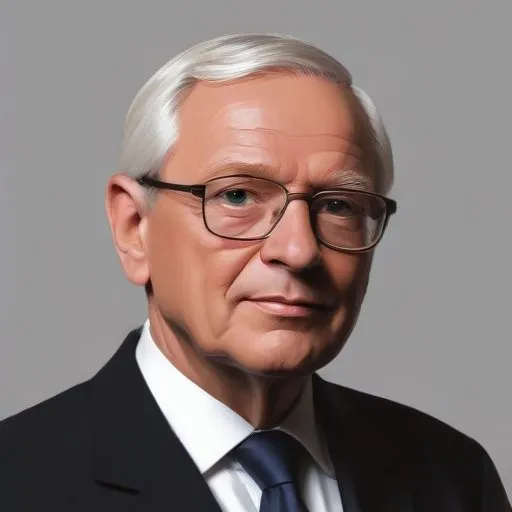
A Dutch economist and politician who served as Minister of Defense and advocated for European integration and economic cooperation. He's known for his efforts to strengthen the European Union.
David van Embden was a Dutch politician and academic, known for his tireless advocacy of pacifism, decolonization, and progressive social and economic reforms. Through his work as a professor of economics and statistics, as well as his involvement in the Freethinking Democratic League and later the Labour Party, van Embden left an indelible mark on Dutch politics and society.
Born on October 22, 1875, in The Hague, Netherlands, van Embden was raised in the Portuguese Jewish community. He studied law at the Municipal University of Amsterdam, graduating cum laude in 1901. This marked the beginning of a lifelong commitment to public service, as he went on to become a professor of economics and statistics at the same university, a position he held from 1905 to 1941.
Van Embden's pacifist convictions were deeply rooted in his religious beliefs and played a significant role in shaping his political ideology. He was a vocal proponent of national disarmament, advocating for a reduction in military spending and promoting peaceful conflict resolution. This commitment to pacifism was particularly noteworthy during a time of great global turmoil, as Europe teetered on the brink of war.
In addition to his pacifist stance, van Embden was a strong advocate for decolonization and progressive social and economic reforms. He believed in the importance of social justice and equality, and worked tirelessly to promote these values through his political and academic work. His commitment to social progress was reflected in his support for the Labour Party, which he joined in 1946.
In 1940, following the German invasion of the Netherlands, van Embden fled to the United Kingdom, where he continued to advocate for pacifism and social reform. After the war, he returned to the Netherlands and resumed his professorship, remaining active in politics until his death in 1962.
David van Embden's legacy as a champion of pacifism and social progress continues to inspire generations. Through his work as a politician, academic, and activist, he left an indelible mark on Dutch society and politics. His commitment to promoting peace, social justice, and equality serves as a powerful reminder of the importance of individual action in shaping a better world.
Born in 1903
A Dutch economist and academic who developed the first national economic model and was awarded the first Nobel Prize in Economics in 1969 for his work on econometrics.
Born in 1895
Developed econometrics, a statistical approach to economic analysis, and founded the discipline of econophysics, earning the first Nobel Prize in Economics in 1969.
Born in 1920
Developed econometric models that accurately predicted economic trends and fluctuations, earning him the Nobel Prize in Economics in 1980.
Born in 1901
A Nobel Prize-winning economist and statistician who developed the concept of Gross National Product (GNP) and was a pioneer in the field of economic growth and development.
Born in 1902
A pioneer in human capital theory, he demonstrated how investments in education and health can boost economic growth and productivity. His work transformed the field of economics and informed policy decisions.
Born in 1905
Developed the input-output method, a mathematical approach to understand the interdependencies of different sectors in an economy, revolutionizing the field of economics.
Born in 1898
A Nobel Prize-winning economist and sociologist who pioneered the concept of institutional economics, shedding light on the role of social and political institutions in shaping economic outcomes.
